Corbridge as a Base for Hadrian's Wall Country: Forts, Trails, Buses and Itineraries
Corbridge sits on Dere Street, a short walk from Hadrian's Wall, with a station on the Tyne Valley line. How to use the village as a base for the Wall: who runs each fort, the Hadrian's Wall Path, the 122 bus, trains, Hadrian's Cycleway and day-by-day itineraries.
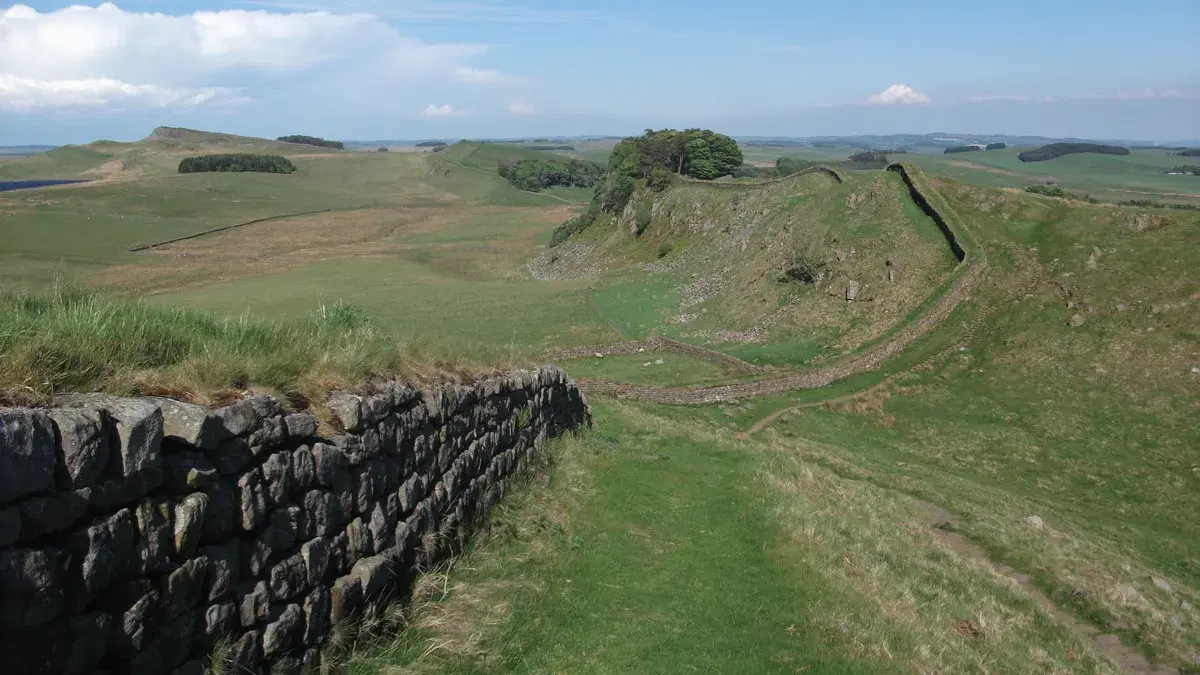
Most visitors to Hadrian's Wall pass through the Tyne Valley without stopping. That is a pity, because Corbridge makes an excellent base. The village has its own Roman site, a railway station on the line that runs along the Wall corridor, buses to Hexham where the dedicated Wall bus starts, and the Wall itself only a few miles to the north. Inns, cafés and a good choice of places to stay mean you can spend the day on the frontier and be back for dinner in a village that has been on the road to Scotland for nearly 2,000 years.
This guide explains how the pieces fit together: who runs each of the main sites, how to reach them without a car, where to walk and cycle, and some suggested plans for a day, a weekend or longer. Opening times and fares change, especially in winter, so the details below are correct as of November 2026 and you should check them before you travel.
Why Corbridge?
Corbridge was part of the Roman frontier before the Wall was built. The Romans built a series of forts here from around AD 86 to guard the crossing of the Tyne on Dere Street, the main road north to Scotland. After Hadrian's Wall was begun in AD 122 the site grew into a supply town for the garrisons along it. English Heritage describes Corbridge Roman Town as the most northerly town in the Roman Empire, and says the Wall lies about 2.5 miles to the north. Our guide to visiting Corbridge Roman Town covers the site in detail, and the Corbridge Hoard and the Corbridge Lion tells the story of its most famous finds.
Dere Street ran north from Corbridge and crossed the Wall at Portgate, close to the modern roundabout where the A68 meets the B6318 Military Road. That junction is the nearest point on the Wall to the village and is where the Hadrian's Wall Path passes closest. The Errington Coffee House at Stagshaw Bank sits right by it and is a popular stop for walkers. The open ground around it was once home to the great Stagshaw Bank Fair.
Corbridge is also one stop east of Hexham on the Tyne Valley railway. That puts the village within easy reach of both the Wall bus at Hexham and the stations further west at Haydon Bridge, Bardon Mill and Haltwhistle.
Who runs what
The Wall is a single World Heritage Site, but its visitor attractions are run by three different organisations. That matters because membership cards, ticket offers and opening times differ between them.
- English Heritage runs Corbridge Roman Town, Chesters Roman Fort and Birdoswald Roman Fort. It also manages Housesteads, along with many free-to-visit stretches of Wall, turrets and milecastles.
- The National Trust owns Housesteads Roman Fort and much of the surrounding central section of the Wall. English Heritage manages the fort itself, so both English Heritage and National Trust members get in free.
- The Vindolanda Trust, an independent charity (registered number 1159798), runs Vindolanda and the Roman Army Museum. Neither English Heritage nor National Trust membership covers these two sites, but the Trust sells a saver ticket for visiting both on the same day.
The main sites, east to west
Chesters Roman Fort
Chesters Roman Fort is at Chollerford, about six miles north-west of Corbridge, and is the closest of the Wall forts. English Heritage describes it as a cavalry fort, home to around 500 cavalrymen. Its best-known feature is the military bath house beside the North Tyne, among the best preserved in Britain. The site also includes the Clayton Museum, which displays finds gathered by John Clayton, the 19th-century Newcastle town clerk who bought up long stretches of the Wall to protect them. On the other bank of the river are the remains of the Roman bridge abutment, and Brunton Turret, one of the best-preserved turrets on the Wall, is less than a mile away. In winter Chesters opens at weekends only, currently 10am to 4pm with last entry at 3.30pm.
Housesteads Roman Fort
Housesteads Roman Fort stands high on the Whin Sill escarpment near Haydon Bridge. English Heritage calls it Britain's most complete Roman fort, with the remains of barracks, granaries, the commanding officer's house and the famous latrines. It also has some of the most dramatic stretches of Wall either side. It is a stiff uphill walk of about half a mile from the car park, and the visitor centre is currently closed, though toilets and refreshments are available in the car park and at the fort. It is open daily, currently 10am to 4pm.
Vindolanda
Vindolanda lies just south of the Wall near Bardon Mill. It is a fort and civilian settlement where excavation is still going on, and it is famous for the Vindolanda writing tablets, the wooden letters and documents that give an unusually personal view of life on the frontier. The museum displays leather, textiles and other finds that survived in the waterlogged ground. The Trust is running a winter programme from 2 November 2026 to 3 January 2027, so check the Vindolanda website for current days and times. The nearest station is Bardon Mill, from which footpaths lead up to the site.
The Roman Army Museum
The Roman Army Museum is at Greenhead, beside Magna Roman Fort and one of the most complete sections of the Wall at Walltown. It focuses on the soldiers of the frontier, with displays on their lives and equipment and the film Edge of Empire. The nearest station is Haltwhistle, and the 122 bus stops outside. The Vindolanda Trust notes that the walk along the Wall between its two sites is about 7.7 miles.
Birdoswald Roman Fort
Birdoswald Roman Fort, over the border in Cumbria near Gilsland, is the furthest of these from Corbridge. English Heritage says it has the longest continuous visible stretch of Wall, and the fort sits on a spur above the River Irthing. It has a café and is on the National Trail. It is currently open at weekends, 10am to 4pm. Without a car, it is best kept for a longer stay, as reaching it means changing buses.
The 122 Hadrian's Wall bus
For most visitors without a car, the key to the central Wall is the Go North East 122, formerly known as the AD122. It runs between Hexham and Haltwhistle, with some journeys going on to Walltown. Its stops include Chesters, Housesteads, Vindolanda, the Roman Army Museum, Walltown and Greenhead. It runs every day of the year except Christmas Day, Boxing Day and New Year's Day, but services are much less frequent in winter, so check the current timetable.
The 122 does not come to Corbridge. Take the train or a bus to Hexham (the 10, 684 or 685 all link the two) and pick it up there. Our guide to getting around Corbridge without a car has the details of local trains and buses.
At the time of writing a single fare is £2.50, and passengers aged 21 and under pay £1. A Northumberland Day Rover costs £6 (£3 for under-21s), and a family ticket is £18. Showing a valid bus ticket gets you 10% off at Vindolanda and the Roman Army Museum and 20% off at Housesteads, Chesters and Birdoswald. To get to Birdoswald, change at Walltown Quarry to the HW1, a separate service run by Reays between Carlisle and Walltown. There are no through tickets.
The Tyne Valley railway
Corbridge station is on Northern's Tyne Valley line between Newcastle and Carlisle. Heading west, trains call at Hexham, Haydon Bridge, Bardon Mill and Haltwhistle, all of which are useful for the Wall. Bardon Mill is the nearest station to Vindolanda, Haltwhistle to the Roman Army Museum and Walltown, and Hexham is where you pick up the 122. Many Corbridge trains start or end at Hexham, so you may need to change there for stations further west.
A good pattern for a car-free day is to take the train west in the morning, use the 122 to hop between the sites, and catch the train home from whichever station you finish nearest.
The Hadrian's Wall Path
The Hadrian's Wall Path National Trail runs for 84 miles (135km) from Wallsend in the east to Bowness-on-Solway on the Cumbrian coast. Natural England's guidance on GOV.UK splits it into stages. The one that passes closest to Corbridge runs from Heddon-on-the-Wall to Chollerford (15.5 miles, or 25km) and crosses the A68 at Portgate. The next stage, from Chollerford to Steel Rigg (12 miles), climbs onto the Whin Sill and gives the classic views of the Wall striding over the crags. It is also the hilliest section.
The trail has a passport scheme, with seven stamping points along the route, which runs from Easter to October. The official advice is that the trail is best walked between Easter and October. The Wall and the buried archaeology alongside it are fragile, and the ground can get very muddy in wet weather, so walkers are asked to stay on the path and not to walk on the Wall itself.
From Corbridge you can join the trail by walking north to Portgate, though this means crossing busy roads. Our guide to walks around Corbridge includes a longer route from Corbridge to Chollerford, about 17km, which links the village with the trail and ends near Chesters.
Cycling: Hadrian's Cycleway
Hadrian's Cycleway, National Cycle Network Route 72, runs from Ravenglass on the Cumbrian coast to South Shields. It passes right through Corbridge on quiet lanes. Heading west it follows the Tyne Valley through Hexham, and heading east it runs towards Ovingham, Wylam and Newcastle. It mostly stays in the valley and does not follow the line of the Wall, so reaching the forts on the high ground of the Whin Sill means some steep climbs.
Note that the Hadrian's Wall Path is a walking trail: much of it is on public footpaths where cycling is not allowed. Our guide to running and cycling in Corbridge covers the local section of NCN 72 in more detail.
Suggested itineraries
These plans assume you are staying in or near Corbridge, and they work best from Easter to October, when the sites have longer hours and the buses run more often. In winter, check which days each site is open before you set out.
Half a day: Roman Corbridge
Spend the morning at Corbridge Roman Town, walking the main street of the supply town and seeing the finds in the museum. In the afternoon, walk or drive north to Portgate for your first look at the line of the Wall. Stop at the coffee house at Stagshaw Bank, then return to the village.
A full day by train and bus
Take the train or the 10 bus to Hexham and catch an early 122 to Housesteads, giving yourself time to walk up to the fort and along the Wall. Ride the bus on to Vindolanda for the afternoon. Then either take the 122 back to Hexham or walk down to Bardon Mill to catch a train home. If you prefer a gentler day, swap Housesteads for Chesters, which is closer, flatter and has the bath house by the river.
A walking day: Corbridge to Chesters
Follow the Corbridge to Chollerford route in our walks guide, joining the Hadrian's Wall Path north of the village and following it west to Chollerford. Finish at Chesters Roman Fort, check the opening hours first, and take the 122 back to Hexham for a train or bus to Corbridge. It is a long day of around 17km, and you should check the time of the last bus before you set out.
A weekend or longer
On a longer stay you can work west along the Wall:
- Day one: Corbridge Roman Town and Chesters.
- Day two: Housesteads and the walk along the crags towards Steel Rigg.
- Day three: Vindolanda and the Roman Army Museum, using the Trust's saver ticket for both.
- With a car or a spare day: add Birdoswald, changing to the HW1 at Walltown.
Our weekend in Corbridge guide has ideas for evenings in the village, and museums near Corbridge compares the museums at each site.
Practical tips
- Check winter hours. Corbridge Roman Town, Chesters and Birdoswald are currently open at weekends only for the winter season, and the Vindolanda Trust runs a separate winter programme.
- Plan around the bus. The 122 is less frequent in winter, so note the last bus back to Hexham before you set off.
- Dress for the weather. The central Wall is high, exposed ground, and it can be much colder and windier than the valley around Corbridge. Wear walking boots, even if you only plan to visit Housesteads.
- Bring your ticket. Keep your bus ticket to get money off at the forts.
- Check your membership. English Heritage and National Trust members get in free at the sites those organisations run, but not at Vindolanda or the Roman Army Museum.
Sources and further reading
- English Heritage: visitor pages for Corbridge Roman Town, Chesters Roman Fort, Housesteads Roman Fort and Birdoswald Roman Fort
- National Trust: Housesteads Roman Fort and the Hadrian's Wall estate
- The Vindolanda Trust: visitor information for Vindolanda and the Roman Army Museum
- Go North East: 122 Hadrian's Wall bus timetable, fares and attraction offers
- GOV.UK (Natural England): Hadrian's Wall Path National Trail guidance (2026)
- Northern: Tyne Valley line timetable
- Walk Wheel Cycle Trust (formerly Sustrans): Hadrian's Cycleway, NCN Route 72
Local businesses mentioned
Corbridge Roman Town
Corchester Lane, Corbridge, Northumberland, NE45 5NT
Chesters Roman Fort
Chollerford, Hexham, Northumberland, NE46 4EU
Housesteads Roman Fort
Haydon Bridge, Hexham, Northumberland, NE47 6NN
Roman Vindolanda
Bardon Mill, Hexham, Northumberland, NE47 7JN
Roman Army Museum
Greenhead, Brampton, Cumbria, CA8 7JB
Birdoswald Roman Fort
Gilsland, Brampton, Cumbria, CA8 7DD
The Errington Coffee House
Stagshaw Bank, Corbridge, Northumberland, NE45 5QB
Never miss what’s on
Join the weekly CorbridgeVillage.live digest — the best events, news and local tips, straight to your inbox. One email a week.
What's On
Jim Ross Interviewed by LJ Ross
See organiser · Corbridge Community Hub, 19 Princes Street, Corbridge
Tynedale v Chester (National League 2 North)
2:00 PM · Tynedale Park, Station Road, Corbridge NE45 5AY
Remembrance Sunday Civic Service
10:40 AM · St Andrew's Church, Market Place, Corbridge NE45 5AA