Visiting Corbridge Roman Town: A Local Guide
A practical guide to Corbridge Roman Town: what you can see, the museum and the Corbridge Hoard, opening hours, getting there, visiting with children and where to eat afterwards.
Half a mile north-west of the village centre, on the edge of fields above the Tyne, lies one of the most remarkable Roman sites in Britain. Corbridge Roman Town is cared for by English Heritage, which describes how Corbridge developed into the most northerly town in the Roman Empire. Historians know it as Corstopitum, though locally it was probably called Coria. This guide covers what you will find there, how to get there and how to make a day of it in the village.
What the site is
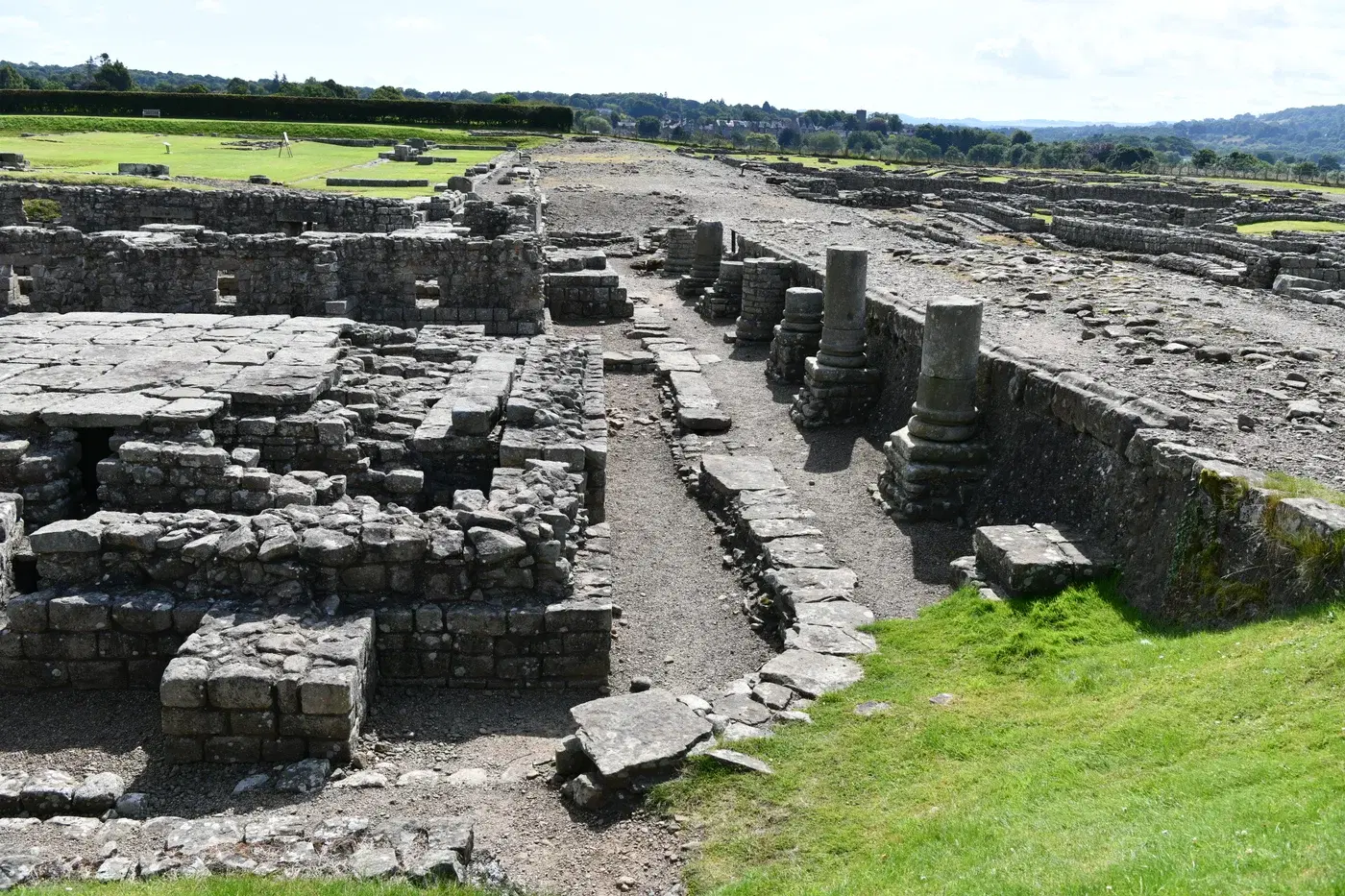
Corbridge began as a series of forts guarding the river crossing, the first founded around AD 86. After about AD 160 it became a supply base and strategic centre on Dere Street, the main Roman road into Scotland, and it fed the garrisons along Hadrian's Wall, two and a half miles to the north. A civilian town grew up around the base, and it seems to have been rapidly abandoned when Roman rule in Britain collapsed in the early 5th century.
What makes the site unusual is that it was a town rather than only a fort. You walk along the line of the Roman main street, with the remains of buildings on either side.
What you can see
The most striking remains are the granaries, the long stone buildings that stored the town's food supply. English Heritage says they were probably rebuilt in their visible, enormous form under the emperor Severus; the west granary dates from between AD 198 and 209. Nearby is the fountain, built in the late 2nd or early 3rd century to give the town a constant supply of fresh water.
The site museum covers many aspects of Roman life. Its best-known find is the Corbridge Hoard, discovered in 1964 in a wooden chest and buried around AD 105 to 120. It contains military equipment and tools, including two suits of segmented plate armour that English Heritage describes as the best preserved ever found. Also on show is the Corbridge Lion, a 3rd-century sandstone carving of a lion over its prey, made for a tomb and later reused as a fountain head. Look out, too, for the tombstone of a young girl shown playing with a ball.
The Romans, Rivers and Rituals exhibition displays Roman objects recovered from the River Tyne, and is included in standard admission. So is an audio tour.
Opening hours and tickets
At the time of writing, in November 2026, English Heritage lists the site as open on Saturdays and Sundays from 10am to 4pm, with last entry at 3.30pm. Visit Northumberland notes that it opens every day in summer, Wednesday to Sunday in spring and at weekends in winter. Hours change through the year, so check the English Heritage prices and opening times page before you set off, and check current prices there too.
Tickets are valid all day. Booking online by midnight the day before saves 15%, though you can still buy on the day at full price. English Heritage members go free.
Getting there
On foot from the village. English Heritage gives the site as half a mile north-west of Corbridge, reached on a minor road and then signposted. It is a short walk from the Market Place.
By train. Corbridge station, on the Tyne Valley line between Newcastle and Carlisle, is about 1.5 miles from the site. English Heritage puts the walk at around 25 minutes.
By bus. The 684 runs all year between Hexham and Corbridge, and the 685 from Newcastle stops at the Angel in the village.
Best for: Arriving by bus? Show your bus ticket to staff on arrival for 20% off a walk-up ticket.
By car. The postcode for sat nav is NE45 5NT (Corchester Lane). There is free parking for 20 cars about 10 metres from the entrance, and further free parking in Corbridge near the river, roughly a mile and a quarter away.
Visiting with children
The site works well for families. There are large open areas for running about, though English Heritage asks for no ball games or kites. The museum has a children's colouring and jigsaw area and a toy and dressing-up box, and the main page mentions a World Builder trail. Pushchairs are allowed, and the toilets include baby changing.
There is no cafe on site, just a vending machine for hot drinks, so many families bring a picnic: you are welcome to eat in the grounds, where there are picnic benches. A small shop sells Roman-themed souvenirs. Dogs on leads are allowed in the grounds, and assistance dogs across the site.
Combine it with the village
Corbridge reused a good deal of its Roman past. St Andrew's Church in the Market Place was founded in the 670s, and the tall arch between its tower and nave is built from the stones of a single Roman arch. The church is open for private prayer from 9.30am to 4pm each day.
Beside the church stands the Vicar's Pele, a medieval fortified tower built partly from Roman stone and now a scheduled monument. Today it houses The Pele, a micro bar serving local ales, coffee and tea. The market cross in the square also stands on a Roman altar from the town.
Going further
Hadrian's Wall is two and a half miles north of the Roman Town. English Heritage notes that the AD122 bus serves Chesters and Housesteads Roman Forts on the Wall; check its timetable if you plan to combine several sites in one day.
Dilston Physic Garden, just over a mile south-west of the village across the Tyne, grows more than 700 plants with histories in health and medicine. From April to October it opens Wednesday to Sunday, 10am to 4pm. From November to 20 December, and from 5 February to the end of March, it opens Friday to Sunday, 12pm to 3pm, and it closes from 21 December to 4 February.
Food in the village afterwards
The Market Place has several options within a few steps of each other. Grant's Bakery has seating overlooking the square, and Tea & Tipple serves light lunches, scones and cakes. On Hill Street, The Corbridge Larder is a deli with a small cafe upstairs, and Coffuffle on Middle Street sells coffee and handmade chocolate truffles.
For a pub meal, The Angel of Corbridge on Main Street serves food at lunch and in the early evening, the Black Bull on Middle Street serves food all day and has a children's menu, and The Golden Lion faces the Town Hall on Hill Street. Opening times change, so check before you go.
Visited recently, or spotted something we should add? Get in touch and help us keep this guide up to date.
Local businesses mentioned
Corbridge Roman Town
Corchester Lane, Corbridge, Northumberland, NE45 5NT
St Andrew's Church, Corbridge
St Andrew's Church, Market Place, Corbridge, Northumberland, NE45 5AA
The Pele
Market Place, Corbridge, Northumberland, NE45 5AW
Dilston Physic Garden
Dilston Physic Garden, Corbridge, Northumberland, NE45 5QZ
Grant's Bakery
1 Market Place, Corbridge, Northumberland, NE45 5AW
Tea & Tipple
18 Market Place, Corbridge, Northumberland, NE45 5AW
The Corbridge Larder
18 Hill Street, Corbridge, Northumberland, NE45 5AA
Coffuffle
3 Jubilee Buildings, Middle Street, Corbridge, Northumberland, NE45 5AT
The Angel of Corbridge
Main Street, Corbridge, Northumberland, NE45 5LA
Black Bull
Middle Street, Corbridge, Northumberland, NE45 5AT
The Golden Lion
Hill Street, Corbridge, Northumberland, NE45 5AA
Never miss what’s on
Join the weekly CorbridgeVillage.live digest — the best events, news and local tips, straight to your inbox. One email a week.
What's On
Tynedale v Chester (National League 2 North)
2:00 PM · Tynedale Park, Station Road, Corbridge NE45 5AY
Remembrance Sunday Civic Service
10:40 AM · St Andrew's Church, Market Place, Corbridge NE45 5AA
Long Weekend Christmas Shopping at Dilston Physic Garden
12:00 PM - 3:00 PM · Dilston Physic Garden, Dilston, Corbridge NE45 5QZ