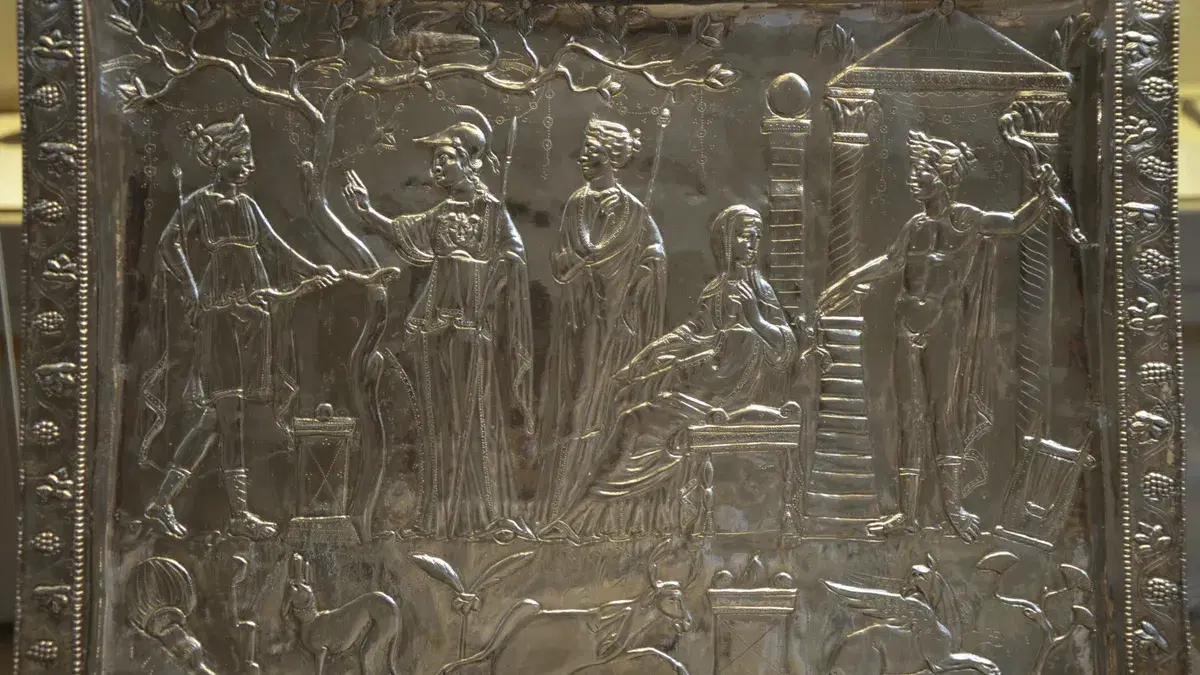
The Corbridge Treasures: the Lanx, the Lion and the Hoard
A silver tray found by a nine-year-old girl in 1735, a stone lion that became a fountain, a soldier's chest of armour dug up in 1964 and two hoards of Roman gold: the stories behind Corbridge's great finds, and where to see them today.
For a village of a few thousand people, Corbridge has given an unusual number of objects to the national story. A Roman silver tray found on its riverbank in 1735 is now in the British Museum. A stone lion uncovered in 1907 is the star of the Roman town's museum. A wooden chest dug up in 1964 changed how historians understand Roman armour. And two hoards of Roman gold coins, found during the Edwardian excavations, ended up in the High Court before they reached London.
This guide tells the story of each find, explains why it matters and says where you can see it now. The dates and details come from the British Museum, English Heritage, Northumberland Archives and the archaeological literature, listed at the end. Where those sources disagree, we say so. For practical information on opening times and tickets, see our guide to visiting Corbridge Roman Town.
Why Corbridge produces treasure
Almost everything in this guide came out of the ground at, or just below, the Roman town half a mile west of the village. The town began as a fort guarding the place where Dere Street, the main Roman road north, crossed the Tyne, and it grew into a supply base for the army on Hadrian's Wall and then a civilian town that lasted until the early 5th century. Four centuries of soldiers, merchants and families left a great deal behind.
People have known that for a long time. English Heritage records that in 1201 King John had the ruins dug for treasure and found only stones "marked with brass, iron and lead". The site was largely ploughed flat by the 18th century, which is one reason so many finds came to light by accident: on the riverbank, in the plough soil, or when the systematic excavations began in 1906. Our long read on Coria, the Roman town tells that story in full.
The Corbridge Lanx
A find on the riverbank, 1735
In February 1735 a nine-year-old girl called Isabel Cutter found a large silver tray on the north bank of the Tyne below Corbridge. The fullest account is by the Oxford historian Francis Haverfield, who in 1914 published the contemporary documents in the Journal of Roman Studies. He places the find about 150 yards below the present bridge (the court record of the time says 200 yards) and names a second girl, Hester Skipsey, aged about ten, as Isabel's companion.
Sources disagree about Isabel's father. Haverfield, working from the 1735 court record, calls him Thomas Cutter, a Corbridge blacksmith. More recent popular accounts, including John Grundy's History of Northumberland (2022), describe him as a cobbler. We have not been able to settle the point.
What happened next is well documented. Thomas Cutter broke off a piece of the rim or foot, weighing 8 ounces, and sold it to Isaac Cookson, a Newcastle goldsmith, in mid February. On 1 March he sold Cookson the rest. Haverfield gives the price as 4s 6d an ounce, £33 6s in all, for 148 ounces of silver.
Treasure trove and a court case
The lord of the manor of Corbridge, Algernon Seymour (later the seventh Duke of Somerset), claimed the tray as treasure trove. On 1 May 1735 a jury at the manor court declared that the plate belonged to the lord and fined Cutter sixpence. Cookson refused to hand it over. On 19 July the Lord Chancellor, Lord Talbot, issued an injunction forbidding him to alter, deface or melt it, and in November he rejected Cookson's legal objection. The tray went to the lord of the manor, and Cookson was reimbursed.
That injunction is probably the reason the tray survives at all. Haverfield shows that it was not the only piece of Roman silver to come out of the Tyne near Corbridge in those years, and the others fared badly:
- A basin, around 1731, found in the river below the bridge, was sold to a Newcastle pewterer for ninepence, resold for £9 and later melted down.
- A two-handled cup, 1733, was found by a fiddler washing in the river and sold for a guinea. Its fate is unknown.
- A bowl, summer 1736, found on the south bank almost opposite the lanx, carried the Christian Chi-Rho monogram six times around its rim. Its later history is unknown.
The British Museum's description suggests that the riverbank was being eroded and was exposing a 4th-century hoard of silver piece by piece. Only the tray survived.
What the lanx shows
"Lanx" is a Latin word for a large dish, and 18th-century scholars applied it to this rectangular tray. According to the British Museum's catalogue, it measures 50.3 by 38 centimetres and weighs 4.6 kilograms. Haverfield noted an inscription on the back recording its weight in Roman units, which matches the modern figure.
The scene on its face is a shrine of Apollo. The god stands at the entrance holding his bow, with his lyre at his feet. His twin sister Artemis enters from the left, and Athena, with her hand raised, is talking to her. Below, an altar is flanked by Artemis's hound, a fallen stag and a griffin, an animal associated with Apollo.
Two women in the centre, one seated and spinning, are harder to identify. The British Museum suggests that if the shrine is the one on the Greek island of Delos, birthplace of Apollo and Artemis, the seated woman may be their mother Leto and the standing woman her sister Ortygia, who in myth became the island itself. That reading is a suggestion, not a certainty, and earlier scholars proposed others.
The British Museum dates the lanx to the 4th century AD. Its place of manufacture is unknown: the museum suggests a Mediterranean city, North Africa or Asia Minor, with Ephesus among the candidates. It compares the lanx with the great platters of the Mildenhall Treasure, which also mix pagan and Christian imagery. A tray decorated with pagan gods, found with a bowl bearing a Christian monogram, is a small window on a frontier town in a century when the empire was changing religion.
From Alnwick to London
The lanx stayed with the lord of the manor's heirs, the Dukes of Northumberland, for more than 250 years. Haverfield, writing in 1914, recorded it at Alnwick. It was later lent to the British Museum, and in 1993 the museum bought it from Henry Percy, 11th Duke of Northumberland, with contributions from the National Heritage Memorial Fund, the Art Fund and the British Museum Friends.
How to see it
The original is in the British Museum in London, registration number 1993,0401.1, and has been shown in Room 49, the Roman Britain gallery. Displays change, so check the museum's collection page before you travel. Closer to home, Historic England's photo archive records a replica of the lanx on display in the museum at Corbridge Roman Town.
The Corbridge Lion
Found in 1907
The second treasure never left Corbridge. The Corbridge Lion was uncovered in 1907, during the second season of the Edwardian excavations at the Roman town. English Heritage, which looks after the site, says it was found in the grounds of a large private house south-west of the town's public area, on the edge of the promontory overlooking the Tyne. With 23 rooms it was the largest house known in Roman Corbridge, with underfloor heating, its own latrines and painted plaster, and it was lived in until the end of the 4th century.
English Heritage's account of the workforce records a small human detail: a labourer called Surtees Forster washed the lion after it came out of the ground.
A tomb sculpture turned into a fountain
The carving shows a male lion pouncing on its prey. The prey is the subject of some debate. It is often described as a stag, but English Heritage points out that its horns and ears suggest a sheep or goat, while its size relative to the lion suggests something more like a cow. The sculptor may simply have made the prey large to make the lion look more impressive.
Lions devouring their prey were a common decoration on Roman funerary monuments, where they are thought to have symbolised the inescapable struggle with death. English Heritage believes the Corbridge Lion was carved for a mausoleum but never actually used on one, because it shows little weathering and may have come straight from a mason's stock. A mausoleum excavated in 1958 at Shorden Brae, about 600 metres west of the town, had a pair of worn lions of the same kind.
Instead, the owners of the big house put it to work. The lion's teeth were removed and its mouth became the spout of a large fountain. The cistern it fed was built in the early 3rd century and went out of use by the start of the next. English Heritage notes that there is no water erosion below the mouth, so a pipe probably carried the water clear of the stone.
That reuse is what makes the lion interesting. A symbol of death from a tomb ended up as a garden ornament in a wealthy household. Whether the owners saw its meaning differently, or simply liked the look of it, English Heritage concludes that we will probably never know.
How to see it
The lion is displayed in the site museum at Corbridge Roman Town, along with the tombstone of a little girl, Vellibia Ertola, shown holding her ball, and a 3rd-century relief of the sun god Sol that was found reused as a floor slab in one of the granaries.
The Corbridge Hoard
A chest under the road, 1964
The third treasure was found in 1964, when excavators digging beneath the later Roman town came across the remains of a wooden chest. It had been buried in one of the early forts, in the road beside the headquarters building, according to English Heritage. The finds were first published by Charles Daniels in Archaeologia Aeliana in 1968, and the full report, Excavations at Roman Corbridge: the Hoard by Lindsay Allason-Jones and Mike Bishop, followed in 1988.
The chest was made of alder planks dovetailed at the corners, bound with iron and covered in leather. As its iron contents rusted, they mineralised the organic material around them, so that wood, leather, rope, cord and even feathers survived in a way that is very rare on a dry site. Inside were:
- Armour: plates from the segmented iron body armour known today as lorica segmentata.
- Weapons: bundles of spearheads still tied with cord, artillery bolts and a sword scabbard.
- Tools and fittings: a pulley block, a lamp, nails, joiner's dogs and a small wooden bucket or tankard.
- Writing materials: wax writing tablets and fragments of papyrus, which are almost unknown elsewhere in Roman Britain.
Why the armour matters
Everyone has seen lorica segmentata: it is the armour of overlapping iron bands worn by legionaries on Trajan's Column in Rome and by every Roman soldier in film. Before 1964, though, nobody knew exactly how it fitted together. The Corbridge pieces were complete enough, with their hinges, buckles and leather straps, for the armour expert H. Russell Robinson and Charles Daniels to work out how a set was assembled. English Heritage puts it simply: before the find, people knew the segmented armour existed but not how it actually worked. Much of the modern picture of a Roman legionary rests on what was learned from this chest.
Accounts differ on how much armour there was. English Heritage's summary describes two suits. Others, drawing on the published report, count six upper and six lower half-units that do not match neatly, which could represent as few as three complete cuirasses or parts of as many as twelve.
When, and why, was it buried?
Sources also differ on the date. One English Heritage page places the burial between about AD 105 and 120, in the second fort. Another English Heritage page, and summaries of the 1988 report, give about AD 122 to 138, in the reign of Hadrian. Both put it in the early years of the frontier, when Hadrian's Wall was being planned or built a few miles to the north.
Nobody knows why a chest of useful equipment was buried and never recovered. Suggestions include a hurried concealment during an attack, a deliberate burial to collect rust and verdigris for medicine, and the disposal of workshop scrap when a garrison moved on, so that an enemy could not use the metal. Each theory has its supporters, and the evidence does not settle the question.
How to see it
Objects from the hoard are on display in the museum at Corbridge Roman Town, and since 2012 the display has included a replica of the armour.
The gold hoards of 1908 and 1911
Two smaller finds are less well known but tell a lively story. Both turned up during the excavations of 1906 to 1914, run by the Corbridge Excavation Committee, whose president was the Duke of Northumberland. Northumberland Archives has published the surviving paperwork.
In September 1908 workmen found a sheet of lead under a floor, with its ends bent over to form a case. Inside were 48 gold coins and a gold ring. English Heritage dates the coins to the late 4th century.
On 4 September 1911 two workmen, Holmes Riley and Edward Coxon, found a bronze jug standing upright about a foot below the surface. Two bronze coins in its neck hid what lay underneath, and when the jug was lifted the weight of gold broke it. The counts differ slightly: the coroner's papers and the committee's own inspection record 159 gold coins (plus the two bronze ones), while English Heritage and other accounts give 160. They run from the reign of Nero to that of Marcus Aurelius, so they were probably hidden in the second half of the 2nd century. One coin, of the empress Faustina, was reported at the time to be one of only two known examples.
The finds led to a dispute over ownership. The Duke of Northumberland, as lord of the manor, told the High Court in 1910 that the 1908 coins were his. The landowner, Captain Cuthbert, also had a claim. Both eventually gave way to the Treasury, and in February 1912 the High Court allowed it to take the 1911 coins from Lloyds Bank in Corbridge. The numismatist George Macdonald published the 1911 find in the Journal of Roman Studies in 1912, noting that the circumstances of the discovery offered no obvious archaeological explanation for why it was there.
Both hoards went to the British Museum, which keeps them intact as complete groups. According to the British Museum's catalogue entry for one of the 1911 coins, the bronze jug itself is in the Corbridge museum.
Treasures in plain sight
Not every Corbridge treasure is behind glass. The village itself is built partly from the Roman town. The tall arch between the tower and nave of St Andrew's Church is made from the stones of a Roman arch, the Vicar's Pele beside it is partly built of Roman stone, and the market cross in the Market Place once stood on a Roman altar. Our Corbridge heritage walking trail takes you past all of them, and interesting facts about Corbridge has more stories.
Planning a treasure trail
- In Corbridge: the site museum at Corbridge Roman Town holds the lion, objects from the 1964 hoard, the 1911 jug and a replica of the lanx. Opening is limited in winter, so check our visiting guide and English Heritage's website first.
- In London: the original lanx and the gold coin hoards are in the British Museum. Check the online collection for current display locations before you go.
- Nearby: for other museums with Roman collections within reach of the village, see museums near Corbridge.
Sources and further reading
- British Museum, collection online, The Corbridge Lanx, 1993,0401.1, also published on Google Arts and Culture.
- F. J. Haverfield, "Roman Silver in Northumberland", Journal of Roman Studies 4 (1914), 1 to 12.
- English Heritage, The Corbridge Lion, Collection highlights, History of Corbridge Roman Town, Significance and Extraordinary Explorations at Corbridge.
- Historic England Archive, photograph of the replica Corbridge Lanx at Corbridge.
- L. Allason-Jones and M. C. Bishop, Excavations at Roman Corbridge: the Hoard, HBMCE Archaeological Report 7 (1988); C. M. Daniels, "A hoard of iron and other materials from Corbridge", Archaeologia Aeliana, 4th series, 46 (1968).
- H. R. Robinson, The Armour of Imperial Rome (1975).
- Northumberland Archives, "Buried Treasure: Who Owns the Gold Coins Found at Corbridge?" (2025).
- G. Macdonald, "The Corbridge gold find of 1911", Journal of Roman Studies 2 (1912).
Know more about any of these finds, or have family links to the Edwardian excavations? Get in touch.
Never miss what’s on
Join the weekly CorbridgeVillage.live digest — the best events, news and local tips, straight to your inbox. One email a week.
What's On
Jim Ross Interviewed by LJ Ross
See organiser · Corbridge Community Hub, 19 Princes Street, Corbridge
Tynedale v Chester (National League 2 North)
2:00 PM · Tynedale Park, Station Road, Corbridge NE45 5AY
Remembrance Sunday Civic Service
10:40 AM · St Andrew's Church, Market Place, Corbridge NE45 5AA