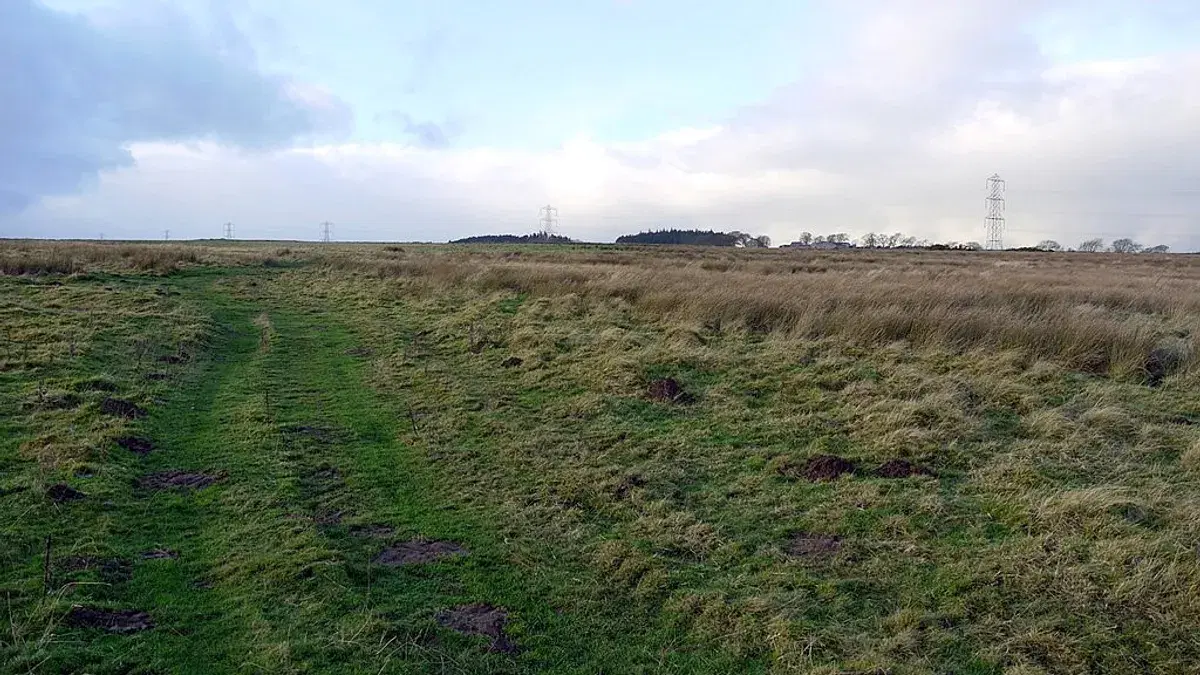
Stagshaw Bank Fair: The Great Cattle and Sheep Fair on the Hill Above Corbridge
For centuries a bare hillside two miles north of Corbridge hosted one of the biggest livestock fairs in England, drawing Scottish drovers, horse dealers, cloth sellers and tinkers. This is the story of Stagshaw Bank Fair, from medieval ironware to its abolition in 1927, and what you can still see today.
Drive north out of Corbridge on the A68 and, just before the roundabout where it meets the Military Road, you cross a stretch of rough, tussocky upland criss-crossed by power lines. There is nothing to suggest that this was once one of the busiest places in the north of England. Yet for several hundred years Stagshaw Bank hosted a fair that a Victorian directory ranked among the largest sheep and cattle fairs in the country. Thousands of animals were driven here from Scotland and the Borders, and dealers, drovers, cloth merchants, pedlars and pickpockets came with them.
This guide pieces together what is reliably known about the fair, from medieval purchase lists to the Home Office order that ended it, and is careful to separate the record from the folklore. The fair has a brief mention in our guides to historic trades and crafts in Corbridge and the history of Corbridge High Street. Here it gets the longer treatment it deserves.
Where the fair was held
Stagshaw Bank lies in Sandhoe parish, about two miles (3km) north of Corbridge. Northumberland's Historic Environment Record, published as Keys to the Past, places the fair "just off Dere Street", the Roman road that ran north from Corbridge to Scotland and which the A68 still follows. A study of the "Great Drift Road", the droving route through the county, is more precise: it puts the fairground in the south-west quarter of the junction of the Military Road (B6318) and Dere Street (A68), close to Portgate, where the Roman road passed through Hadrian's Wall.
The location explains a great deal. Dere Street was a ready-made route from the Scottish border, and Hadrian's Wall and the later Military Road ran east to Newcastle and west to Carlisle. A fair at the crossroads of the two was well placed for animals coming south and buyers coming from every direction. Keys to the Past records that livestock bought at Stagshaw were moved on to Corbridge, Hexham and further afield.
Keys to the Past also identifies a building connected with the fair. The former Fox and Hounds Inn, a Grade II listed 18th-century building that was raised and extended in the early 19th century, stands near the site. The HER notes that the fair was once held on the moorland immediately to its west. It is now a private building, so it is something to glimpse from the road, not to visit.
How old was it?
Nobody has yet produced a founding charter for Stagshaw Bank Fair, and we have not found one either. The honest answer is that its origins are unclear, and claims that it goes back to the Romans or the Anglo-Saxons should be treated as legend.
The earliest firm evidence we have found comes from the end of the 13th century. Northumberland County Council's Extensive Urban Survey of Corbridge, drawing on the Northumberland County History (Craster, 1914), says ironwork was a principal commodity at Stagshaw Fair. Purchase lists from 1298 and 1299 include horseshoes, nails and other ironware bought there. That suggests a fair already well established by about 1300, with a trade far wider than livestock alone.
Sources differ on the details. A Wikipedia article on fairs claims that fairs were held at Stagshaw by 1293. A 1993 pipers' journal article (cited below) says the fair ran "from the 12th century". Neither gives a source we could check, so we treat both dates as unconfirmed. Keys to the Past is cautious, saying only that the fair is best known from the medieval and post-medieval periods and may be older still.
The fair's link with Corbridge itself is clear. King John made Corbridge a royal borough in 1201, and the town had a weekly market from his reign. The Urban Survey records that this market failed between the late 16th and mid-17th centuries, and was gone by 1663. Stagshaw Fair, however, carried on, and Craster called it "the principal fair in the Tyne Valley". The Survey asks a pointed question that is still unanswered: why did the town market die, while a fair "held in a field alongside the ruins of Hadrian's Wall with no village facilities" survived?
The drovers' fair
The likely answer is the droving trade. From the 17th century onwards, and above all in the 18th and early 19th centuries, huge numbers of black cattle and sheep were walked south from the Scottish Highlands and Borders to feed the growing towns of England. The Urban Survey, citing Graham, Hepple and Craster, says that Stagshaw became a market for sheep and cattle brought by Highland drovers over the border at Carter Bar and down through Redesmire. The Great Drift Road paper notes that the fairground lay nearly 70 miles east of the great Falkirk Tryst, one of the largest cattle markets in Scotland, and the two belonged to the same network.
A research paper on Northumberland's drove roads goes further and describes Stagshaw Bank as the "most important of all" the fairs on that network. We saw that paper only as a quoted extract, so we report it as one historian's judgement. For anyone wanting the full picture, the book Drove Roads of Northumberland by Ian Roberts, Richard Carlton and Alan Rushworth is the standard modern account.
A calendar of fairs
Stagshaw was never just a single day. Keys to the Past lists a whole calendar of fairs on the bank:
- 6 May, for cattle and sheep
- Whitsun, for horses and cattle
- 4 July, for horses, cattle and sheep
- two fairs in August, around the 5th, for sheep only
- 26 September, for cattle and sheep
Other sources give a slightly different picture, which is a sign of how the fair changed over time. Samuel Lewis's Topographical Dictionary of England, a 19th-century gazetteer, lists fairs at Stagshaw Bank on Whitsun eve and on 4 July. It adds a "tryst" fair on 24 November, established in 1820. Whellan's 1855 directory says "the great fair of Stagshaw Bank" was held every Whitsuntide and Midsummer on "a large common two miles north of the town", and that the Whitsun fair was "considered one of the largest sheep and cattle fairs in England". By the 1920s the Hexham Courant was describing the remaining fair as "always held on the last Thursday in November", so the late tryst may have outlived the others.
The 4 July Midsummer fair seems to have been the best known, and it is the one most often linked with Corbridge in local memory.
More than cattle: cloth, horses and pedlars
The livestock were the core of the fair, but they were not the whole of it. Lewis noted that at the July fair "a great quantity of linen and woollen cloth, brought from Scotland, is exposed for sale". The medieval lists of ironware show that metal goods had been a big part of the trade from the start. Horse dealing was also important, and horses appear in several of the fair dates listed above.
A fair of this size drew a crowd far beyond the dealers. There were people selling food, drink and cheap goods, entertainers, and the usual fairground hangers-on. This side of Stagshaw is less well documented and is mostly known through later reminiscence. "Medieval Travellers", an article in the December 1993 issue of Common Stock, the journal of the Lowland and Border Pipers' Society, describes gangs from Tarset and Tarryburn in Redesdale who came to the fair to loot. It says the trouble was serious enough that Redesdale youths were barred from Newcastle apprenticeships. The article gives no source for these claims, so we treat it as a secondary account that we have not traced to a primary record.
Something of the fair's reputation survives in dialect. One local blogger records that "It's like Stagey Bank Fair in here" is still said in the region about any chaotic, crowded scene. There is even a tune. A reel called "Stagshaw Bank Fair" is printed in Northumbrian Minstrelsy, the collection of Northumbrian songs and tunes published by John Collingwood Bruce and John Stokoe in 1882.
Opening the fair in Corbridge
The fair belonged to the lord of the manor, who by the 19th century was the Duke of Northumberland. It was opened with a ceremony in Corbridge itself. A postcard from 1904, now in the Mary Evans Picture Library, shows Michael Jones reading the rules of the fair at the Market Cross. The fair was proclaimed by the Duke's bailiff. The 1993 Common Stock article adds that the Duke's piper then led the crowd from the Market Cross up the hill to the fairground. That is consistent with the proclamation tradition, but again it is a later account.
The proclamation is a reminder that the borough and the fair were bound together, even after the town's own weekly market had gone. It is also the part of the story you can still connect with in the village today (see below).
Decline and abolition
The 19th century brought the changes that killed the fair. Railways could move animals faster and more cheaply than drovers on foot, and auction marts in market towns offered dealers a fixed, regular place to trade. The message written on the back of that 1904 postcard puts it in five words: "the marts is spoiling the fairs".
The Hexham Courant charts the slow fade, through clippings collected by the Bellingham Heritage Centre:
- In June 1884 the fair was "slow and dull".
- In July 1905 the paper wrote that for young people it was "an old tale retold", and described an "almost deserted field".
- By June 1925 the reporter found nobody present but tinkers, and wrote that the fair had lost its former glory.
In February 1927 the Courant reported that the Home Secretary, Sir William Joynson-Hicks, would consult local authorities on a request from the Duke of Northumberland to abolish the fair. In April 1927 the paper reported that the fair had been abolished. The Home Secretary acted under the Fairs Act 1871 on the Duke's petition, and there was practically no opposition. Some later accounts say the fair carried on until 1928. That may reflect a last informal gathering or a later date for the formal order taking effect, but we have found no clear evidence either way. The Courant's April 1927 report is the most direct source we have.
What happened to the site
The fair left no buildings behind. Keys to the Past records the site, and the Fox and Hounds stands as a reminder, but the fairground itself went back to rough grazing. Writers who walk the area describe it today as bleak, tussocky ground under the pylons, which is exactly what the hero photograph above shows.
Corbridge did not lose its connection with farming shows. For much of the 20th century the Northumberland County Show was held at Tynedale Park in Corbridge, before moving to Bywell Hall in 2013. Sources differ on when it arrived: some say it had been at Corbridge since 1948, others give a 66-year run. Either way, it was a modern and quite different event, not a continuation of Stagshaw Fair.
See it today
The Market Cross. Start in the village, where the fair was proclaimed. According to the Urban Survey, the old market cross now stands against the churchyard wall of St Andrew's Church. It is a composite piece, with a Roman base, a 13th-century shaft and an 18th-century head, and a cast-iron cross was put up in the Market Place in 1814. Our Corbridge heritage walking trail takes you past both.
Stagshaw Bank and Portgate. The fairground lay beside the A68 and B6318 junction, about two to three miles north of the village. There is no public monument or interpretation board for the fair, and the A68 is a fast road with no pavement for much of the way, so this is not a walk to do along the roadside. The best way to see the area is from the Hadrian's Wall Path, which passes the junction. The Errington Coffee House at Stagshaw Bank, by the junction, makes a good base. From here you can look across the open ground where the drovers once gathered. Our guide to walks around Corbridge covers the footpaths north of the village.
Dere Street. The A68 north of Corbridge follows the line of Dere Street, the route the drovers' cattle came down. Its southern end begins at Corbridge Roman Town, where the Roman road crossed the Tyne.
The Heritage Centre. For local photographs, cuttings and memories, the volunteer-run Corbridge Heritage Centre on Princes Street is the place to ask. It is also the right place to share any family stories or pictures of the fair.
What we still don't know
A few gaps remain, and we would rather say so than fill them with guesswork:
- The founding date. There is no confirmed charter, and the oldest evidence we can verify is the purchase lists of 1298 and 1299.
- The exact boundaries of the fairground. These probably shifted over the centuries.
- The last fair. The date of the final gathering is uncertain, with sources pointing to 1927 or 1928.
- The fair at its peak. Contemporary descriptions of the busiest days are thin. Most of the colourful detail comes from later retellings.
If you have documents, photographs or family memories of the fair, the Heritage Centre would like to hear from you.
Sources and further reading
- Keys to the Past (Northumberland and Durham HER): Stagshaw Bank Cattle Fair, Sandhoe (N8679); Sandhoe parish summary (N13799); former Fox and Hounds Inn (N22485)
- Northumberland County Council and English Heritage, Northumberland Extensive Urban Survey: Corbridge, drawing on H. H. E. Craster, A History of Northumberland, vol. X (1914)
- Samuel Lewis, A Topographical Dictionary of England, entry for Corbridge
- William Whellan, History, Topography and Directory of Northumberland (1855), via Co-Curate
- Hexham Courant reports of 1884, 1905, 1925 and 1927, via the Bellingham Heritage Centre newspaper archive
- "The Great Drift Road", droving route study, Northumberland
- "Medieval Travellers", Common Stock (Lowland and Border Pipers' Society), vol. 8 no. 2, December 1993
- J. C. Bruce and J. Stokoe, Northumbrian Minstrelsy (1882)
- Ian Roberts, Richard Carlton and Alan Rushworth, Drove Roads of Northumberland (The History Press)
Local businesses mentioned
The Errington Coffee House
Stagshaw Bank, Corbridge, Northumberland, NE45 5QB
St Andrew's Church, Corbridge
St Andrew's Church, Market Place, Corbridge, Northumberland, NE45 5AA
Corbridge Community Partnership
Former Methodist Church, Princes Street, Corbridge, Northumberland, NE45 5DB
Corbridge Roman Town
Corchester Lane, Corbridge, Northumberland, NE45 5NT
Never miss what’s on
Join the weekly CorbridgeVillage.live digest — the best events, news and local tips, straight to your inbox. One email a week.
What's On
Jim Ross Interviewed by LJ Ross
See organiser · Corbridge Community Hub, 19 Princes Street, Corbridge
Tynedale v Chester (National League 2 North)
2:00 PM · Tynedale Park, Station Road, Corbridge NE45 5AY
Remembrance Sunday Civic Service
10:40 AM · St Andrew's Church, Market Place, Corbridge NE45 5AA