Corbridge the Frontier Town: Scottish Raids, Reivers and Pele Towers
How medieval Corbridge went from one of the richest boroughs in Northumberland to a battered border village: the Scottish raids of 1138 to 1346, plague, the reiving centuries, and the fortified towers that survive, from the Vicar's Pele and Low Hall to Aydon Castle and Halton.
Walk along Corbridge's Main Street today and it is hard to picture the village as a front line. Yet for about four hundred years, from the 12th century to the union of the English and Scottish crowns in 1603, Corbridge sat in one of the most fought-over stretches of country in Britain. Scottish armies burned it more than once, the Black Death emptied whole villages around it, and for generations its people lived with the threat of cattle raids from across the Border and from closer to home.
The evidence is still standing. Corbridge has two medieval tower houses in the village itself, and within a few miles there are three more fortified buildings, including one of the best-preserved fortified manor houses in England. This long read tells the story of the frontier centuries and finishes with a guide to the towers you can see.
A rich medieval borough
It is worth starting with how much there was to lose. After the Norman Conquest, Corbridge grew into a substantial market town on the old Roman road north, at the point where it crossed the Tyne. According to Keys to the Past, Northumberland's historic environment record, it was a borough by the middle of the 12th century, and King John made it a royal borough in 1201, with weekly markets.
In the 13th century it was, by Keys to the Past's account, the second largest borough in the region after Newcastle. Its streets were lined with smiths, tanners and traders; our guides to the history of Corbridge's high street and historic trades and crafts in Corbridge cover that side of the story. Its church, St Andrew's, was enlarged with aisles and transepts. It was precisely this wealth, and its position on the main road from Scotland, that made it a target.
The Scottish raids
1138: David I
The first recorded Scottish occupation came during the civil war between Stephen and Matilda, when David I of Scotland invaded northern England in support of his niece Matilda. The chronicler Richard of Hexham, a canon of the priory a few miles up the river, wrote that "the king of Scotland with a considerable force occupied Corbridge". David's campaign ended in defeat at the Battle of the Standard later in 1138, but Scottish kings would hold Northumberland for some years afterwards.
1296: the first great burning
The real disaster came with the outbreak of the Wars of Scottish Independence. In the spring of 1296, as Edward I invaded Scotland, a Scottish army led by the Scottish earls crossed into Northumberland. Keys to the Past records that this invasion destroyed Hexham and Corbridge, leaving Corbridge in a state of almost total destruction, and that the king afterwards gave the townspeople 40 oaks towards rebuilding.
Local plaques and several popular accounts, including our own heritage trail, credit this 1296 raid to William Wallace. The contemporary record does not support that. The April 1296 invasion was led by the Scottish earls, with John Comyn, Earl of Buchan, among them, and the chronicle known as the Scalacronica describes Hexham priory being burned at this time. Wallace did not appear as a leader until the following year.
1297: William Wallace
Wallace did come in 1297. After his victory at Stirling Bridge that September, he led a large raid deep into Northumberland and Cumberland, and Wikipedia's account of the raid, drawing on the chronicles, records that his forces burned Corbridge. For a town that had barely started rebuilding, it was the second burning in two years.
1312: Robert the Bruce
After Edward I's death in 1307 the war turned in Scotland's favour, and Robert the Bruce began raiding northern England to extract payments. In August 1312 (some accounts say 1311) he burned Hexham and Corbridge and used Corbridge as his base while his brother Edward Bruce and Sir James Douglas raided further south. The bishop and people of Durham bought a truce. The amount varies between sources, and we have not found a reliable figure to quote.
1346: David II
The last of the great burnings came in October 1346. David II of Scotland invaded England while Edward III was fighting in France, and according to local histories his army burned Corbridge on its way south. The campaign ended at the Battle of Neville's Cross outside Durham, where David was defeated and captured. Aydon Castle, outside Corbridge, was taken in the same year.
Plague, decline and the deserted villages
The raids were not the only blow. The Black Death reached the area in 1349, and the 14th century as a whole was disastrous for Corbridge and its neighbours. A number of small settlements around the town never recovered. Keys to the Past records several deserted or shrunken medieval villages in the parish, among them Shildon, Portgate (which had its own tower), Thornbrough and Dilston, and a hamlet called Spredden that was attacked in 1391 and later lost.
The town itself shrank. By the late 16th century Corbridge had declined almost to a village, and its market had gone before 1663.
Living on the Border
The century or so after 1350 is when the fortified buildings of the Corbridge area went up or were strengthened. The threat was no longer only royal armies. Through the 15th and 16th centuries the English and Scottish Borders were notorious for reiving: raiding for cattle, sheep and horses, often by family groups who answered to no king. North Tynedale and Redesdale, a short ride to the north-west of Corbridge, were home to some of the most notorious reiving families on the English side.
Wikipedia's account of Corbridge, drawing on the county history, describes how this shaped daily life between about 1300 and 1700. Livestock was brought into the town at night, and watches were kept at both ends of the street. Those with the means built in stone, typically a tower with a vaulted ground floor where animals could be shut in, and living rooms above reached by a narrow stair.
Corbridge was never a walled town. Its defence was this scatter of private towers and the watch kept on the street. The arrangement only really ended after the crowns of England and Scotland were united under James VI and I in 1603, and the Borders were brought under control over the following decades.
The Vicar's Pele
The most famous of Corbridge's towers stands in the south-east corner of the churchyard. The Vicar's Pele is a small stone tower built for the parish priest, partly from Roman stone taken from the Roman town. It is listed at Grade I and is a scheduled monument.
Sources differ on its date. Keys to the Past dates it to about 1300 on the evidence of its style, while Historic England and many local accounts give about 1318. Either way, it was in place by 1415, when it appears in a list of Northumberland fortresses drawn up for Henry V. Its walls are about 1.3 metres thick, and Keys to the Past describes it as one of only three fortified vicarages in the county. It served as the vicarage until the early 17th century.
Today the tower has an unusual second life. It houses The Pele, a micro bar, so on the days it is open you can go inside one of the Border's medieval towers for a drink. Our guide to churches in Corbridge has more on the tower's connection with the parish.
Low Hall
At the eastern end of Main Street stands Low Hall, often called the oldest house in Corbridge and sometimes known as Baxter's Tower. It began, according to Keys to the Past, as a 13th-century hall house, to which a three-storey tower with a vaulted ground floor was added at one end in the 15th century, when the threat from raiders made a defensible block worth the cost.
The house was remodelled in later centuries (a sundial on it is dated 1700) and restored around 1890. It is listed at Grade I. Low Hall is a private home, so please view it from the road. It is stop four on our Corbridge heritage walking trail, which also takes in the Vicar's Pele.
Aydon Castle
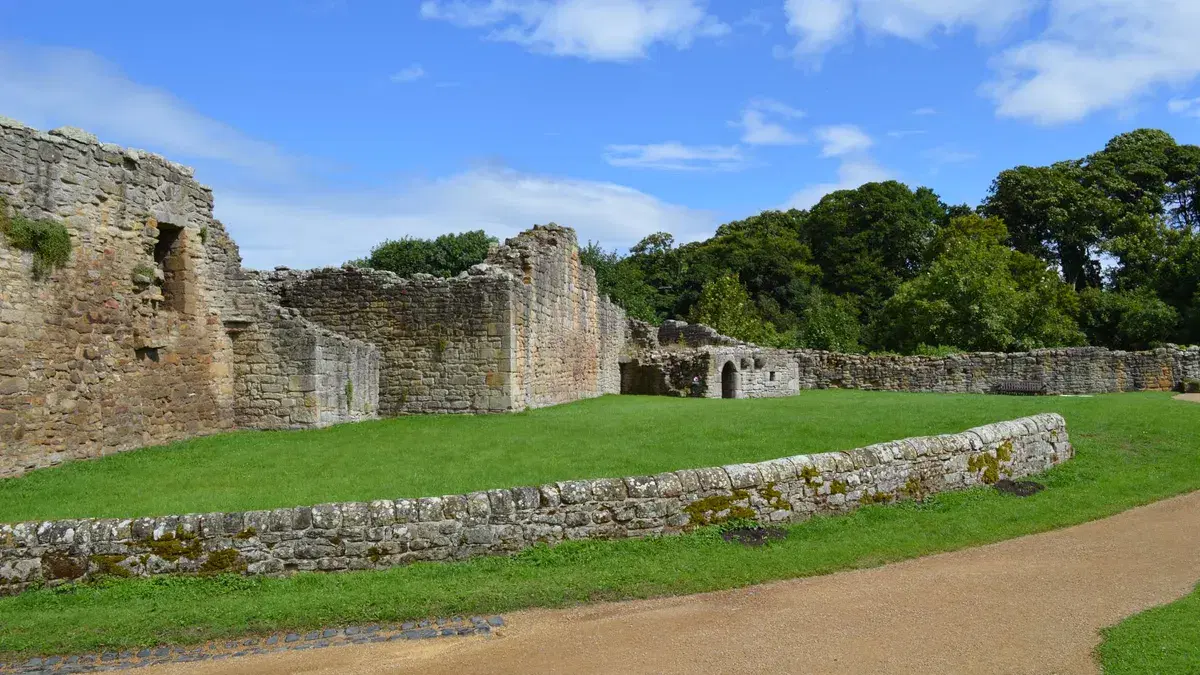
A short walk north-east of the village, on a steep bank above the Cor Burn, Aydon Castle is the best place near Corbridge to understand what life was like in a fortified house on the Border. English Heritage calls it "one of the least-altered fortified medieval manor houses in England".
Built as a manor house, fortified for war
Aydon was not built as a castle. Keys to the Past dates the earliest buildings to about 1280, probably for Robert de Raymes, and describes them as an undefended manor house. Other accounts place the main building work a little later, after the Raymes family acquired the estate in the 1290s. What is agreed is that the outbreak of war changed everything. Keys to the Past notes that Aydon was among the first places attacked in the early 14th-century wars, and on 5 April 1305 Robert de Raymes received a licence from Edward I to crenellate, that is, to fortify the house. Battlements and a curtain wall followed.
Attacked again and again
It did not help much. English Heritage records that Aydon was attacked at least three times. Keys to the Past says the Scots took it in 1315, that it was seized and plundered again in 1317, and that it was taken once more in 1346. Accounts of 1315 differ in detail: some say de Raymes himself was captured, others that the custodian, Hugh de Gales, handed it over. By 1450 the house was described as ruinous.
From Carnabys to farmers
In 1541 Aydon came to Sir Reynold Carnaby, who repaired it (his work has been confirmed by tree-ring dating). After his death in 1543 his brother Cuthbert continued the work. The estate was sold in 1653, and in the 17th century the house was turned into a farmhouse, with farm buildings added in the 18th century. The Blackett family owned it in the 20th century. Aydon was lived in continuously until it passed into state guardianship, which is the main reason it survived so complete: there was never a point at which it was abandoned and quarried.
Visiting
Inside, you can see the great hall, chambers with fireplaces, a garderobe (medieval toilet), the battlements and the walled orchard. Aydon is less than a mile from the Hadrian's Wall Path and makes a good destination for a walk from the village; our guide to walks around Corbridge describes the Aydon Castle circular. English Heritage currently lists the castle as closed for the winter, reopening in 2027, so check dates before you set out.
Halton Castle
North of Corbridge, close to Hadrian's Wall, Halton Castle is another of the area's Border towers. Historic England's list entry describes a Grade I pele tower of the 13th or 14th century with 15th and 17th-century alterations, and a manor house added in 1695. The tower is first recorded in 1382 and appears in the 1415 list of fortresses alongside the Vicar's Pele.
Halton is a private home and is not normally open, although its gardens have occasionally opened to visitors. Please respect the owners' privacy.
Dilston and the other towers
South of the river, the tower at Dilston was built in the 15th century by the Claxton family and later became the core of the Radclyffe family's house. Its story, and that of the Earls of Derwentwater who lived there, is told in our long read on the Earls of Derwentwater and Dilston. Portgate, on the Roman road north of Corbridge where it crosses Hadrian's Wall, also had a tower, according to Keys to the Past. Our guide to the lost buildings of Corbridge covers several other vanished structures.
A frontier walk around Corbridge
If you want to see the frontier landscape in a day, a good route is:
- Start at the Vicar's Pele in the churchyard, and look at the solid lower walls and small upper windows.
- Walk east along Main Street to see Low Hall from the road.
- Head north out of the village on the Aydon Castle walk, following the Cor Burn, to see how Aydon uses the steep ravine for defence (from the outside if it is closed).
- Back in the village, finish in the Market Place, the heart of the medieval borough that the raiders came for.
For the earlier layers of the village's history, see our long read on Anglo-Saxon Corbridge, and visit Corbridge Roman Town, whose stones went into the Vicar's Pele.
Best for:
Low Hall and Halton Castle are private homes and Dilston Castle stands in college grounds. Aydon Castle is run by English Heritage and is closed for the winter, reopening in 2027: check the English Heritage website for dates and prices.
Sources and further reading
- Keys to the Past (Northumberland HER): records for the medieval borough of Corbridge (N13011), the Vicar's Pele, Low Hall and Aydon Castle (N9957).
- Historic England list entries for the Vicar's Pele, Low Hall, Aydon Castle and Halton Castle.
- English Heritage, Aydon Castle visitor pages and history.
- Richard of Hexham, chronicle of the acts of King Stephen, for 1138.
- The Scalacronica of Sir Thomas Gray, for the 1296 burning of Hexham.
- Wikipedia articles on Corbridge, William Wallace's raid of 1297 and the Bruce raids of 1311 to 1312, used for leads and cross-checked.
Know more about Corbridge's towers, or the old watch on the street? Get in touch.
Local businesses mentioned
Never miss what’s on
Join the weekly CorbridgeVillage.live digest — the best events, news and local tips, straight to your inbox. One email a week.
What's On
Jim Ross Interviewed by LJ Ross
See organiser · Corbridge Community Hub, 19 Princes Street, Corbridge
Tynedale v Chester (National League 2 North)
2:00 PM · Tynedale Park, Station Road, Corbridge NE45 5AY
Remembrance Sunday Civic Service
10:40 AM · St Andrew's Church, Market Place, Corbridge NE45 5AA