Anglo-Saxon Corbridge: A Saxon Church, a Murdered King and the Battles of Corbridge
Corbridge between the Romans and the Normans: the Saxon church of St Andrew's built from Roman stone, the monastery recorded in 786, the killing of King Aethelred I in 796, and the Viking-age Battle of Corbridge, which historians still argue was one battle or two.
When the Roman army left Britain in the early 5th century, the town it had built beside the Tyne, Coria, did not simply vanish. Over the next six hundred years the Anglo-Saxon kingdom of Northumbria grew up around it, and a new settlement took shape half a mile to the east, on the site of the present village. Corbridge became a place where bishops were consecrated, where a king was killed, and where Viking and Scottish armies fought one of the most important battles of the 10th century in the North.
Much of this story survives only in a few lines of medieval chronicle, and some of it is still argued over by historians. But one building from the period still stands in the middle of the village, and it is in daily use. This long read pieces together what is known, what is tradition, and where you can see it today.
From Roman town to Anglian settlement
The Roman town at Corbridge was abandoned as a working town in the years after Roman rule ended. But people did not stop using the site. Northumberland's historic environment record, Keys to the Past, records Anglo-Saxon burials found during the excavations of 1907 and 1908 at the Roman site, with grave goods including brooches, beads, part of a scabbard and a small pot. Two further burials found in 1947 and 1948 were dated to the later 5th or early 6th century, and the finds were given to the Museum of Antiquities in Newcastle.
Those early graves matter. They suggest that people with Anglo-Saxon dress and burial customs were living around Corbridge within a few generations of the end of Roman Britain, long before there was a church or a written record. For the Roman town itself, and what happened to it, see our guide to visiting Corbridge Roman Town.
The Anglo-Saxon settlement grew up on the higher ground to the east, around the site of the church, where the village still is. The Romans had left a ready-made quarry behind them, and the Anglo-Saxon builders used it.
St Andrew's Church: the Saxon fabric
St Andrew's Church is the oldest building in Corbridge still in use, and one of the most important Anglo-Saxon churches in Northumberland. Historic England's list entry (it has been Grade I since 1969) dates the nave to the late 7th or 8th century.
When was it founded?
Nobody knows exactly. Keys to the Past says the church is believed to have been founded between 674 and 678, and the parish dates Christian worship here to about 670. Local tradition links the founding to St Wilfrid, the forceful bishop who built the great church at Hexham in the 670s. The connection is plausible, as Hexham is only four miles away and was Wilfrid's own foundation, but no early source names Wilfrid as the founder of Corbridge, so it should be read as tradition, not record.
What the Saxon church looked like
According to Keys to the Past, the first church had three parts: a nave, a small chancel to the east and a porch at the west end. The western porch is a feature Corbridge shares with a small group of early churches in England, sometimes called the "Kentish" type after the early churches of Kent. Later, probably in the 11th century, the porch was raised into the tower that still stands.
Historic England's list entry notes two blocked windows of pre-Conquest date above the north arcade inside the nave. They are reminders that the nave walls are essentially the Saxon walls, pierced by later medieval arcades when aisles were added in the 13th century.
The Roman arch
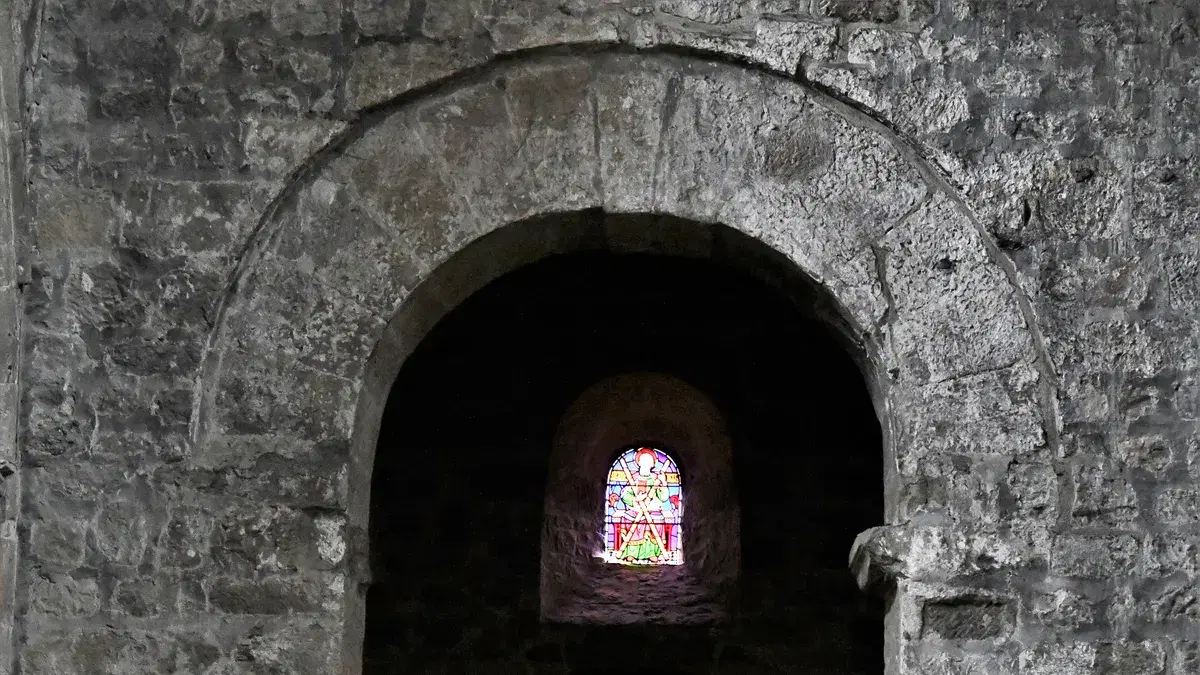
The most famous feature is the arch between the tower and the nave. Keys to the Past describes it as about 5.6 metres high and built from the stones of a single Roman arch, re-erected here, with the supporting piers made up of Roman stones from a mix of sources. Historic England's list entry describes it as thought to be a re-set Roman arch. Where the original stood is not known for certain, but the Roman town half a mile away is the obvious source. It is the clearest example in the village of the Anglo-Saxon habit of building with Roman stone, and it is the arch shown at the top of this page.
The same thing happened on a bigger scale at Hexham, where Wilfrid's crypt beneath Hexham Abbey is built largely of Roman stone thought to have come from Corbridge. Our guide to churches in Corbridge covers the later medieval building and today's services.
The monastery of 786
The first written mention of Corbridge as a religious centre comes from the late 8th century. A northern chronicle, the Historia Regum traditionally attributed to Symeon of Durham and later copied by Roger of Howden, records for the year 786 that a bishop named Aldulf was consecrated "at Corbridge" by Archbishop Eanbald of York and two other bishops. Keys to the Past notes that the record refers to "a monastery called Corbridge".
That is the only evidence for a monastery here. No other monastic buildings have been found. In Anglo-Saxon usage the word could describe a church served by a small community of clergy, the kind of "minster" common in the period, so it need not mean a large enclosed abbey. What it does show is that Corbridge was important enough in the 780s for an archbishop to hold a consecration there.
The killing of King Aethelred, 796
Ten years later Corbridge appears in the chronicles again, this time for a murder. Aethelred I of Northumbria had one of the most turbulent careers of any Anglo-Saxon king. He first ruled from 774 to 779, was driven out, and returned to the throne in 790. His second reign was marked by the execution of rivals and, in 793, by the Viking raid on Lindisfarne.
The Historia Regum, as translated in Roger of Howden's chronicle, records that "king Ethelred was slain at Cobre, on the fourteenth day before the calends of May", that is, 18 April 796. Cobre is taken to be Corbridge. Wikipedia's account, drawing on the same chronicles, says he was killed by a group of conspiring nobles. His successor, Osbald, lasted only 27 days before abdicating, and two years later the same chronicle refers to "the murderers of king Ethelred" taking part in a further rising under a leader named Wada.
Why the king was at Corbridge is not recorded. A royal visit to a place with a church, a crossing of the Tyne and the old Roman road north would not have been unusual, but anything beyond the bare fact of his death here is guesswork.
The Battle of Corbridge
The most dramatic episode in Corbridge's early history happened more than a century later, in the age of the Vikings. By the early 900s the Viking kingdom of York controlled much of southern Northumbria, while the north, from the Tees to the Forth, was held by English lords ruling from Bamburgh. To the north again was the growing kingdom of the Scots under Constantine II.
The armies
In 918, according to the Annals of Ulster, a Viking leader called Ragnall (in Irish sources Ragnall ua Ímair, a grandson of Ímar) who had come over from Ireland, was campaigning in Northumbria. Against him came Constantine, King of Alba, with an army of Scots. On their side, by most accounts, was Ealdred, the English lord of Bamburgh. The battle was fought at Corbridge, presumably because of the Roman road and the river crossing that made it the natural meeting point.
What happened
The Annals of Ulster give the fullest account of the fighting. Ragnall divided his army into four columns. The Scots defeated three of them, but the fourth, held back under Ragnall himself, came out from hiding behind a hill and fell on the Scots from the rear. The Annals report heavy losses on both sides and no clear victory. The Scottish chronicle known as the Chronicle of the Kings of Alba, by contrast, records a battle at "Tinemore" (usually identified with this one) and claims it for the Scots. Most modern historians call the result indecisive.
It was not indecisive for long. The next year, 919, Ragnall took York and made himself king there. The Historia de Sancto Cuthberto, a history of the lands of St Cuthbert's church compiled at Durham some time after 1031, adds that Ragnall took over church lands between the Tyne and the Tees and gave them to two of his followers, named Scula and Onlafbal. For the community of St Cuthbert, the battle was remembered as the moment their estates passed into Viking hands.
One battle or two?
Here the historians part company. The Historia de Sancto Cuthberto appears to describe two separate battles at Corbridge, one in which Ragnall defeated Ealdred and Constantine and a later one. In an influential paper of 1950, F. T. Wainwright argued that there really were two battles, one in about 914 and one in 918, and this view was followed by Sir Frank Stenton, Alfred Smyth and Nick Higham.
More recent scholars have been sceptical. Clare Downham and Alex Woolf, both writing in 2007, and Tim Clarkson in 2014, argue that the Historia's two accounts are confused versions of a single battle, fought in 918, and that the earlier date rests on a misreading of a source compiled more than a century after the events. Others, including Donnchadh Ó Corráin and Marios Costambeys, have continued to refer to two battles. The honest answer is that the evidence is thin and late, and there is no agreement.
Where was it fought?
No one knows. There is no battlefield site, no memorial and, as far as we could find, no archaeology that can be tied to the battle. Some websites claim that the church at Corbridge was damaged by the Danes in 919, but we have not found that in any of the early sources or in the county's historic environment record, so we have left it out.
Late Saxon Corbridge
The church survived the Viking age, and in the 11th century it was given its tower. Keys to the Past records several finds from this later period:
- a fragment of an 11th-century carved slab, possibly part of an altar
- an 11th-century cross that once stood at the top of a gable
- a fragment of an Anglo-Danish grave slab, carved in the mixed Anglo-Scandinavian style of the period
- a late 9th-century coin found in 1858 in a grave beneath the chancel
Together they suggest a church that was cared for and used for burial right through the period of Viking rule in the North. The village also had a watermill in the Anglo-Saxon period: timbers found in the river below the village were radiocarbon-dated to that era, as described in our guide to the lost buildings of Corbridge.
By the time of the Norman Conquest, Corbridge was a substantial settlement with a church, a mill and a river crossing. In the 12th century it became a borough with a market, and its story moves into the period of the Scottish wars, told in our long read on Corbridge as a frontier town. The church passed to new owners too: Henry I granted it to his chaplain in the early 12th century, and it was later given to the priory at Carlisle.
Seeing Anglo-Saxon Corbridge today
Almost everything that survives from this period is in or close to the church, and all of it is easy to see.
St Andrew's Church
St Andrew's is in the middle of the village, off the Market Place, and is open daily. Go inside and stand in the nave looking west: the tall, narrow arch in front of you is the Roman arch, with the tower beyond it. Look up above the north arcade for the blocked Saxon windows. Outside, the lower part of the tower is the Saxon west porch, raised into a tower in the 11th century. Our Corbridge heritage walking trail starts close by.
Corbridge Roman Town
Corbridge Roman Town, run by English Heritage, is the quarry the Saxon builders used. The early Anglo-Saxon burials were found there, and walking the site makes it easy to see why the stone was so tempting. Check opening dates before you go, as the site has reduced winter hours. For Roman treasures found at Corbridge, see our long read on the Corbridge lanx and the Corbridge lion.
Hexham Abbey
Four miles west, Hexham Abbey has the Anglo-Saxon crypt built under Wilfrid's church in the 670s. It is the best place nearby to get a sense of the scale of Wilfrid's building, and of how much Roman Corbridge contributed to it.
Our museums near Corbridge guide lists other collections in the area.
Best for:
St Andrew's is a working parish church. Visitors are welcome during the day, but please avoid wandering around during services, weddings and funerals.
Sources and further reading
- Keys to the Past (Northumberland HER): St Andrew's Church, Corbridge (N8996), and the records of Anglo-Saxon burials at the Roman site (N9176 and N9177).
- Historic England, list entry for the Church of St Andrew, Corbridge (Grade I), which draws on H. M. and Joan Taylor, Anglo-Saxon Architecture (1965).
- The Historia Regum attributed to Symeon of Durham, in the translation of Roger of Howden's Annals, for the entries for 786 and 796.
- The Annals of Ulster and the Chronicle of the Kings of Alba for the battle of 918.
- The Historia de Sancto Cuthberto, for Ragnall's seizure of church lands.
- F. T. Wainwright, "The battles at Corbridge", Saga-Book (1950); Clare Downham, Viking Kings of Britain and Ireland (2007); Alex Woolf, From Pictland to Alba (2007); Tim Clarkson, Strathclyde and the Anglo-Saxons in the Viking Age (2014).
- Wikipedia articles on Aethelred I of Northumbria and the Battle of Corbridge, used as a guide to the scholarship.
Know of any other Anglo-Saxon finds from Corbridge? Get in touch.
Never miss what’s on
Join the weekly CorbridgeVillage.live digest — the best events, news and local tips, straight to your inbox. One email a week.
What's On
Jim Ross Interviewed by LJ Ross
See organiser · Corbridge Community Hub, 19 Princes Street, Corbridge
Tynedale v Chester (National League 2 North)
2:00 PM · Tynedale Park, Station Road, Corbridge NE45 5AY
Remembrance Sunday Civic Service
10:40 AM · St Andrew's Church, Market Place, Corbridge NE45 5AA