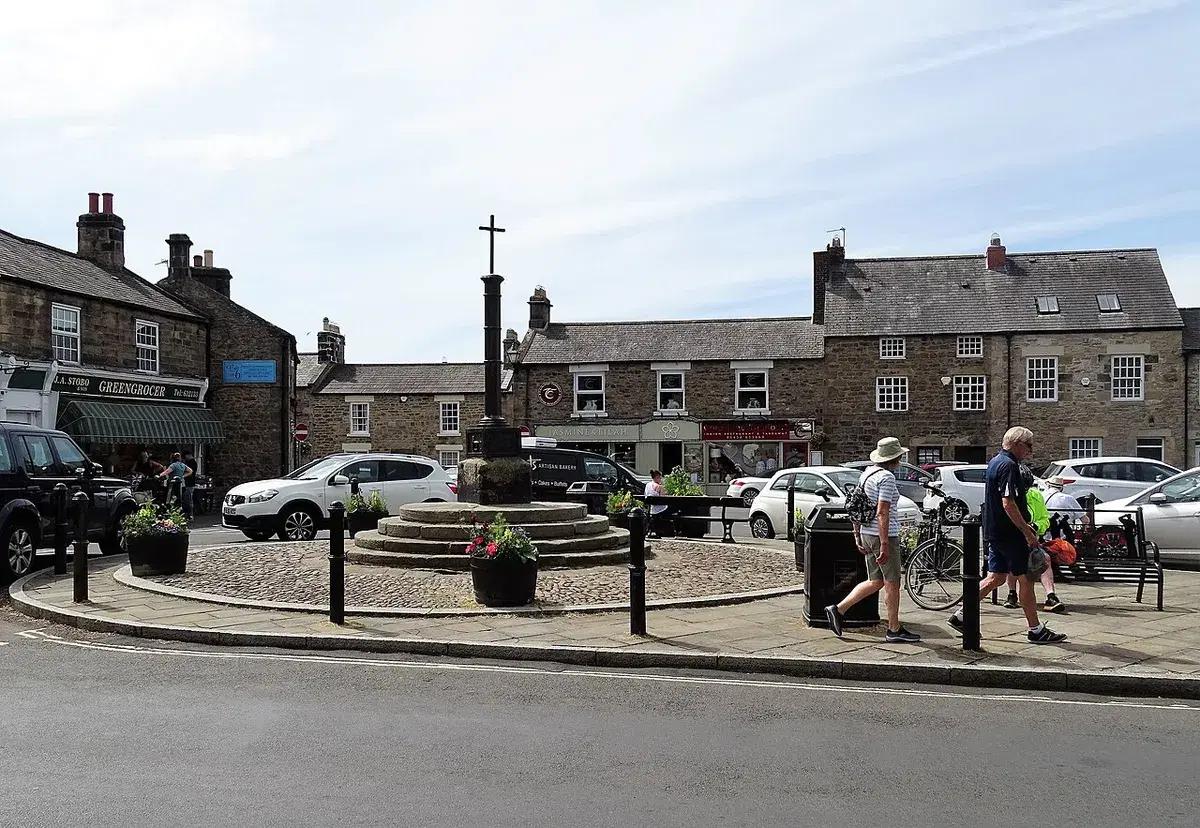
The History of Corbridge's High Street and Market Place
How Corbridge's shopping streets grew from a royal borough market of 1201: the market crosses and pants, the smiths of Smithgate, the coaching inns, the Victorian Town Hall of 1887 and the independent shops that fill the old buildings today.
Corbridge does not have a street called High Street. Its shopping centre is a tight knot of streets around the Market Place: Middle Street and Front Street running east, Hill Street and Princes Street to the north-east, Watling Street heading north and Main Street carrying traffic east towards Newcastle. Most of the shops sit in buildings that are two or three hundred years old, and a few are much older.
This guide traces how that trading centre grew, shrank and grew again. Dates come from the Northumberland Historic Environment Record (Keys to the Past) and the Historic England list entries unless we say otherwise. For a walking route that takes in the main buildings, see our Corbridge heritage walking trail.
A medieval royal borough
Corbridge was already a borough when Henry II came to the throne in 1154, and in 1201 King John made it a royal borough. It sat where two ancient roads met, the Roman Dere Street running north and the route along the Tyne valley, and that made it a natural place to trade. Weekly markets were held in the Market Place from King John's reign.
The 13th century was the high point. Keys to the Past describes Corbridge then as the second largest borough in the region after Newcastle. The street names hint at what was made and sold: Main Street was once called Smithgate, after its blacksmiths, and a medieval street called Hidemarket suggests tanning. Brick-lined tan pits were reportedly found nearby around 1760.
Raids, plague and decline
The prosperity did not last. A Scottish invasion in 1296 burned most of the town, and the king gave the burgesses 40 oaks to rebuild. Wikipedia records that Scots led by William Wallace burned Corbridge again the following year. Border warfare continued through the 14th century, and the Black Death of 1349 cut the population further.
The buildings of this period are defensive. The Vicar's Pele, a stone tower in the corner of the churchyard built for the parish priest in the 14th century, appears in a list of fortresses drawn up for Henry V in 1415. Low Hall at the east end of Main Street began as a hall house and had a pele tower added at one end in the 15th century. By the late 16th century Corbridge had declined almost to a village, and its market had disappeared before 1663.
Smiths, cobblers and Stagshaw Fair
Trade carried on even without a weekly market. The Provost's account of 1525 records four new forges, and there were still five smiths in the village in 1855.
The big commercial event was Stagshaw Bank Fair, a large livestock fair held on Stagshaw Bank, north of the village. Purchase lists from 1298 and 1299 survive, including horseshoes, nails and ironware. The fair was traditionally held on 4 July, and it was proclaimed first in Corbridge Market Place.
In the first half of the 19th century, Keys to the Past lists shoemaking, lime burning and market gardening as Corbridge's main industries. Corbridge Pottery on Milkwell Lane opened around 1840 and closed around 1910.
The Market Place: crosses and pants
The Market Place has two market crosses. The older one is a mix of Roman, 13th-century and 18th-century work: its base is thought to be a reused Roman altar and its shaft is medieval. It was taken away in the early 19th century and later returned, and now stands against the churchyard wall near the Vicar's Pele.
Its replacement, in the middle of the Market Place, is the cast iron cross of 1814 on a stepped stone base, paid for by the Duke of Northumberland. A year later the Duke paid for a pant, a public water fountain, inscribed with the name of Hugh Percy, Duke of Northumberland, and the date 1815 in Roman numerals. Pants like this brought spring water to the village before piped supplies.
Coaching inns
Corbridge's position on the road between Newcastle and Carlisle filled it with inns, and several still trade:
- The Angel of Corbridge on Main Street is a 17th-century inn extended in the 18th century. From 1752 until the railway arrived it was the town's posting inn, where coaches changed horses.
- The Black Bull on Middle Street carries dates of 1755 and 1765.
- The Golden Lion on Hill Street was built in 1768 with stone from Dilston Hall, the demolished home of the Earls of Derwentwater.
- The Wheatsheaf on St Helen's Street dates from the mid-18th century and was enlarged in the mid-19th century.
The Boots and Shoes, another posting inn, stood on Water Road, the old name for Front Street. It has since been demolished. Our guide to the oldest pubs in Corbridge tells their stories in more detail.
Georgian houses and shops
Many of the shop buildings started life as Georgian town houses, and some still carry their dates. On Front Street, Nos 8 and 10 are dated 1752, with the initials M B over the door of No 10, and were heightened in the early 19th century. On Princes Street, Cross House East and Cross House West were built as a pair in 1754 for Eliezer Birch. On Main Street, a pair of listed houses once known as Eastfield, home of the Walker family, go back to the late 16th or early 17th century in part. On Hill Street, Nos 14 and 16 are probably 18th-century houses that were raised and remodelled in the later 19th century.
The railway and the Victorian village
Turnpiking Dere Street in 1800 improved the roads, but the real change came with the Newcastle and Carlisle Railway in the 1830s. The station was built south of the river, and the village grew a little. The railway made it easy to commute to Newcastle, and in the late 19th century Victorian mansions went up on Prospect Hill.
New buildings followed in the centre. A Primitive Methodist chapel opened in 1867; it is now Forum Books, the independent bookshop, where the old pulpit is now a children's reading corner. On Front Street, Nos 12 to 16 are a terrace of about 1880.
The Town Hall of 1887
The most striking Victorian building is the Town Hall on Princes Street, at the top of Hill Street. A company of local businessmen raised the money for it to mark Queen Victoria's Golden Jubilee. It was designed in an English Renaissance style, with shops on the ground floor, an assembly hall for about 500 people above and a central three-stage tower, and it cost about £2,000. It opened on 18 June 1887. The architect's name appears as F. Emily in the Historic England list entry and as Frank Emley elsewhere.
The hall was a centre of village life for decades, but in the late 1970s the company that owned it ran into financial difficulties and was wound up. Community events moved to the Parish Hall on St Helen's Street, and the Town Hall turned to commercial uses, including a cafe, an art gallery and a restaurant.
The 20th century and today
For much of the 20th century, Main Street carried the A69 between Newcastle and Carlisle, with all its through traffic. That changed in 1977, when the A69 was moved onto a new road north of the village and the centre became quieter.
Today the old buildings around the Market Place are full of independent businesses. Grant's Bakery and Tea & Tipple are a few steps from the 1814 cross, the Vicar's Pele is now a micro bar, and Corbridge Library is on Hill Street. Our guide to shopping in Corbridge covers the shops trading today, and our interesting facts about Corbridge has more stories from the village's past.
Best for: Most of the buildings in this guide are listed and stand in the Corbridge Conservation Area. Many are private homes, so please look from the street unless a building is open as a shop, pub or cafe.
Local businesses mentioned
The Angel of Corbridge
Main Street, Corbridge, Northumberland, NE45 5LA
The Golden Lion
Hill Street, Corbridge, Northumberland, NE45 5AA
Black Bull
Middle Street, Corbridge, Northumberland, NE45 5AT
The Wheatsheaf
St Helens Street, Corbridge, Northumberland, NE45 5HE
The Pele
Market Place, Corbridge, Northumberland, NE45 5AW
Forum Books
The Chapel, Market Place, Corbridge, Northumberland, NE45 5AW
Grant's Bakery
1 Market Place, Corbridge, Northumberland, NE45 5AW
Tea & Tipple
18 Market Place, Corbridge, Northumberland, NE45 5AW
Corbridge Library
Hill Street, Corbridge, Northumberland, NE45 5AA
Never miss what’s on
Join the weekly CorbridgeVillage.live digest — the best events, news and local tips, straight to your inbox. One email a week.
What's On
Jim Ross Interviewed by LJ Ross
See organiser · Corbridge Community Hub, 19 Princes Street, Corbridge
Tynedale v Chester (National League 2 North)
2:00 PM · Tynedale Park, Station Road, Corbridge NE45 5AY
Remembrance Sunday Civic Service
10:40 AM · St Andrew's Church, Market Place, Corbridge NE45 5AA