The Lost Buildings of Corbridge
The tolbooth, two medieval churches, the manor hall of the lords of Corbridge, a chapel on the old bridge, the Roman bridge and Dilston Hall: the Corbridge buildings that have vanished, and where to find their traces today.
Corbridge looks like a village that has changed very little, but in the Middle Ages it was one of the most important towns in Northumberland, with its own tolbooth, a manor hall, at least three churches and a bridge with a chapel on it. Most of those buildings have gone, some so completely that their sites are now gardens and allotments. This guide follows them through the historic environment records kept by Northumberland County Council on its Keys to the Past website, which is the main source for the dates below.
The Roman bridge
The oldest lost structure is the Roman bridge that carried Dere Street, the main Roman road north, across the Tyne beside the Roman town. It stood upstream of the present bridge. The antiquary John Leland noticed its remains in 1540, and it was excavated in 1906, when archaeologists estimated it had about ten piers and was some 154 yards long.
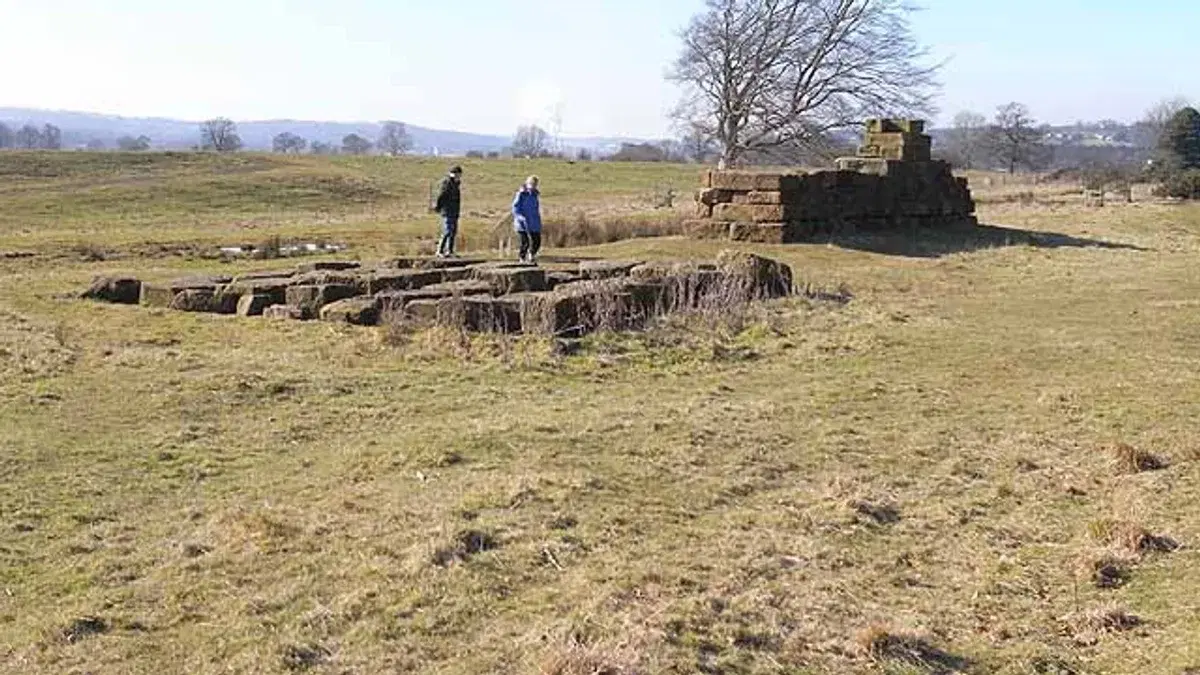
In 1840 the agent of Greenwich Hospital, which then owned the Dilston estate, took many of its stones to build a water wheel at Dilston Mill. The southern abutment can still be seen on the riverbank in dry weather, and large dressed blocks from the bridge approach are on display near the river. The town the bridge served is open to visitors as Corbridge Roman Town.
The Anglo-Saxon watermill
In the riverbed below the village, timbers from an Anglo-Saxon watermill have been found on the north bank. Radiocarbon dating confirmed their age, and an evaluation by Tyne and Wear Museums in 1995 found two stone floors and evidence that the mill probably used a horizontal wheel. Nothing is visible above the water.
The tolbooth
Every medieval market town needed a tolbooth, where market tolls were collected and the borough court met. Corbridge's stood near the east end of St Andrew's Church, with a court room above shops. By 1480 it was recorded as waste and razed, a sign of the town's decline in the later Middle Ages. A burgage plot of 1532 was still "called Tolbooth", and by 1702 its stones had been carted away to build a house at Prior Mains.
One writer believed the old Methodist chapel south-east of the church, now Forum Books, stands on the tolbooth site. When the chapel was investigated in 1994, archaeologists found burnt material and medieval pottery, including at least three jugs and a bowl, though not the building itself.
Trinity Church
Corbridge once had a second church dedicated to the Holy Trinity, first mentioned in 1356. It was still standing in 1549 but became ruinous soon after, and around 1710 the antiquary John Warburton described it as "a ruinous chapel". Its burial ground was known as the Trinity Kirk Garth.
The ruins were cleared before the end of the 18th century and the site became a garden. Today it lies under Trinity Terrace, which keeps the name. In 1888 about a dozen Norman plinth stones were found still in place, and burials have turned up several times since, including eight skeletons found at No 8 Trinity Terrace in 1992.
St Helen's Chapel and the manor hall
St Helen's Street takes its name from a chapel first referred to around 1300, in a deed naming the street. It was probably the private chapel of the manor hall built by Robert FitzRoger, lord of Corbridge. The chapel was ruinous by about 1710, a gable was pulled down in 1802, and the last of its chancel wall had disappeared by 1914.
The manor hall itself, home of the lords of Corbridge in the 13th and 14th centuries, stood on what are now the Chains allotments. It was already the "auld halles" in 1352, and in 1663 only "two stone gavells called by the name of ye Hall Walls" survived. Excavations in 1992 to 1994 behind Corbridge Parish Hall on St Helen's Street found medieval walls, and a fragment of old walling near the Parish Hall's boundary may belong to the chapel.
The medieval bridge and its chapel
Before the present bridge, Corbridge had a medieval one. In 1235 the burgesses paid for permission to build a bridge over the Tyne, and it was in place by 1256. It was often in disrepair over the following two centuries.
Like many medieval bridges it carried a small chapel, dedicated to St Mary the Virgin. In 1401 the Pope granted an indulgence for the chapel, but by 1428 it was ruinous again. The old bridge was replaced in 1674 by the seven-arched stone bridge that still carries traffic into the village, and no trace of its predecessor survives.
The market cross
The old market cross stood in the Market Place until 1807, when it was moved to Anderson Place in Newcastle. It now stands outside St Mary's Roman Catholic Cathedral there. The Roman altar that had served as its base went to the Society of Antiquaries in 1824. The cast-iron cross in the Market Place today dates from 1814.
Dilston Hall
Just south of the river, the Earls of Derwentwater had a large Elizabethan and Jacobean house at Dilston. In 1710 the third Earl pulled it down and began a grand new mansion, but he was executed for his part in the 1715 Jacobite rising before it was finished. The estate passed to Greenwich Hospital, and the unfinished mansion was demolished in 1765. Only the older tower survives, as Dilston Castle, which is listed Grade I. The stone was put to use elsewhere: The Golden Lion on Hill Street says it was built in the mid 18th century with stone from Dilston Hall.
Seeing what survives
Several of these sites are on the Corbridge heritage walking trail, and you can walk from Trinity Terrace to St Helen's Street and the Market Place in a few minutes. For the buildings that did survive, see our history of Corbridge high street and churches in Corbridge.
Know of another lost Corbridge building, or have old photographs? Get in touch.
Local businesses mentioned
St Andrew's Church, Corbridge
St Andrew's Church, Market Place, Corbridge, Northumberland, NE45 5AA
Corbridge Parish Hall
St Helen's Street, Corbridge, Northumberland, NE45 5BE
The Golden Lion
Hill Street, Corbridge, Northumberland, NE45 5AA
Corbridge Roman Town
Corchester Lane, Corbridge, Northumberland, NE45 5NT
Forum Books
The Chapel, Market Place, Corbridge, Northumberland, NE45 5AW
Never miss what’s on
Join the weekly CorbridgeVillage.live digest — the best events, news and local tips, straight to your inbox. One email a week.
What's On
Jim Ross Interviewed by LJ Ross
See organiser · Corbridge Community Hub, 19 Princes Street, Corbridge
Tynedale v Chester (National League 2 North)
2:00 PM · Tynedale Park, Station Road, Corbridge NE45 5AY
Remembrance Sunday Civic Service
10:40 AM · St Andrew's Church, Market Place, Corbridge NE45 5AA