Corbridge Heritage Walking Trail
A self-guided heritage walk around Corbridge: the 1674 bridge that survived the great flood, two medieval tower houses, a Saxon church with a Roman arch, the King's Oven, the market crosses and pants, and on to the Roman town.
Corbridge packs nearly two thousand years of history into a few streets. This self-guided trail links the main listed buildings in the village centre in a loop of roughly a mile and a half, starting and finishing at the railway station, with an optional extension to Corbridge Roman Town. Allow an hour for the village loop at a gentle pace, longer if you go inside the church.
Most of the stops are private homes or working pubs and shops, so look from the street unless a building is open to the public. The dates below come from the Historic England list entries; where local sources disagree, we say so.
For longer countryside routes, see our guide to walks around Corbridge.
1. Corbridge station
Start at Corbridge station on the Tyne Valley line, south of the river. The railway between Newcastle and Carlisle reached Corbridge in the 1830s, and the original station building, now a restaurant, is listed at Grade II. The station is about half a mile from the village centre, which is why Corbridge never grew down to the river on this side.
2. Corbridge Bridge
Walk north over the Tyne on Corbridge Bridge. Built in 1674, it has seven arches with triangular cutwaters between them and small refuges in the parapet where pedestrians could step out of the way of carts. It is listed at Grade I.
Its claim to fame is the great flood of November 1771. Historic England's list entry calls it "the only bridge in Tynedale to survive" that flood. The southern arch was rebuilt in 1829 and the bridge was widened in 1881. There was a medieval bridge here before it, and before that a Roman one, carrying Dere Street, the main Roman road north to Scotland, over the river. Remains of the Roman bridge are said to survive in the riverbed.
3. The Angel and Main Street
Over the bridge, walk up into the village to the Angel of Corbridge on Main Street. Historic England lists it as a 17th-century inn, extended in the 18th century; look for the sundial above the door with the initials of Edward and Anne Winship. Our guide to the oldest pubs in Corbridge has more on the inns.
4. Low Hall and Monksholme
Walk east along Main Street to Low Hall at the eastern edge of the old village. It is listed at Grade I and is often described as the oldest house in Corbridge. It began as a hall house in the late 13th or early 14th century; a defensive pele tower was added at one end later in the Middle Ages, when Scottish raids were a real threat, and the house was remodelled in the 16th and 17th centuries and restored around 1890. Low Hall is a private home, so view it from the road.
Almost opposite is Monksholme, which was once an inn called the New Inn.
5. The pant on Main Street
Head back west along Main Street towards the Market Place. Look out for the stone pant, a public drinking fountain, one of several put up in the early 19th century to bring spring water to the village. Sources give 1815 or 1818 for this one. A listed spring, Spout Well, on Spoutwell Lane, was the village's main water source for centuries.
6. The Market Place and the crosses
The Market Place is the heart of the old village. Corbridge was an important medieval town: King John made it a royal borough in 1201, and Scottish raids, including one led by William Wallace in 1296, and the Black Death all took their toll.
In the middle stands the Market Cross of 1814, paid for by the Duke of Northumberland, with an unusual cast iron shaft and cross on a stepped stone base. It is sometimes called the Percy Cross. The older market cross is now set against the churchyard wall near the Vicar's Pele. Its shaft is medieval, it was removed from the Market Place in the early 19th century, and it was re-erected in its current position in the 1970s. Britain Express says its base is a reused Roman altar.
7. St Andrew's Church
St Andrew's Church is listed at Grade I and is one of the oldest churches in Northumberland. The parish says Christians have worshipped here since about 670, when Saint Wilfrid founded a monastery. The lower part of the tower began as a Saxon porch, and the tall arch between the tower and the nave was built from the stones of a complete Roman arch, almost certainly brought from the Roman town. The church is usually open daily for visitors, so this is the one stop where you can go inside.
The lychgate at the churchyard entrance is the village's First World War memorial, dated 1920.
8. The King's Oven
Just outside the churchyard wall, west of the tower, is the King's Oven, a communal bread oven first recorded in 1310 and used, according to Britain Express, until the 19th century. Historic England lists the churchyard wall, hearse house and entrance gateway here together as an 18th-century structure.
9. The Vicar's Pele
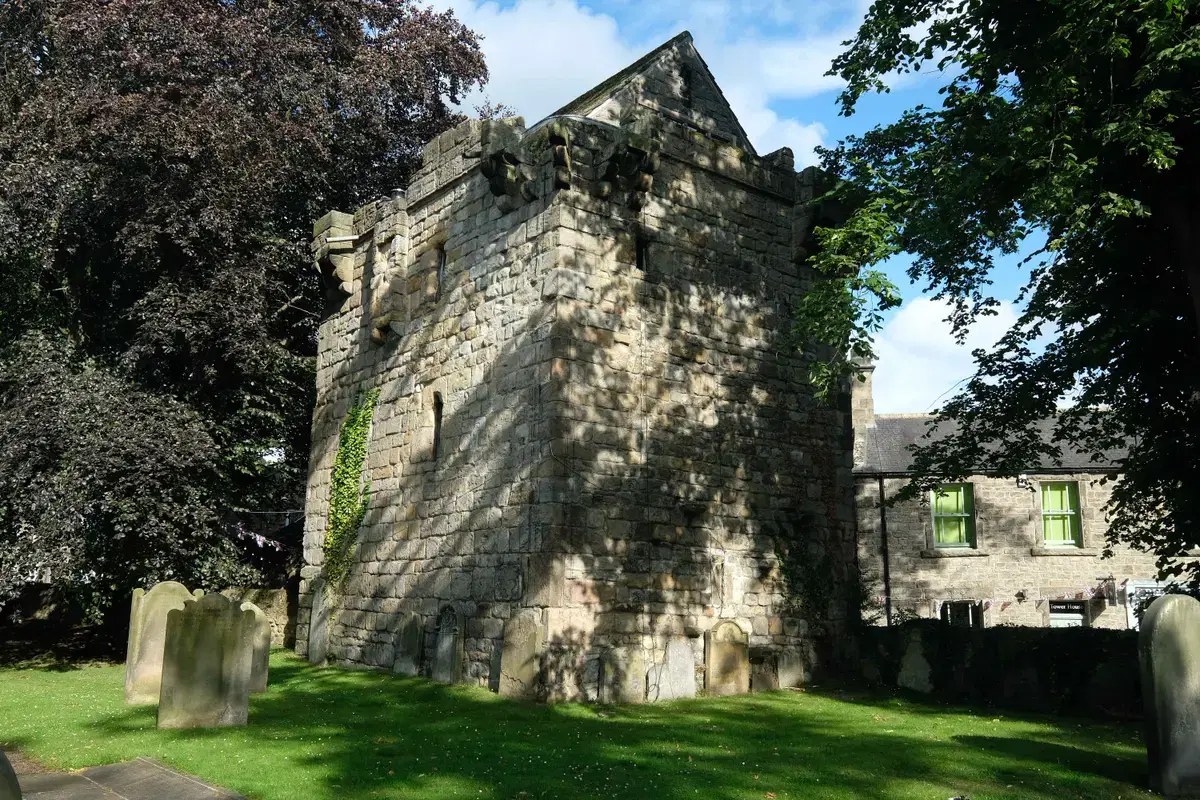
In the south-east corner of the churchyard stands the Vicar's Pele, a fortified tower of about 1318, listed at Grade I and a scheduled monument. It was built for the parish priest, partly with stone from the Roman town, with walls around 1.3 metres thick. It now houses The Pele micro bar, so on the days it is open you can see the inside too.
10. Hill Street and the Town Hall
From the Market Place, walk east along Hill Street. The Town Hall, built in 1887 with shops on the ground floor, closes the view along Hill Street from Princes Street. Opposite is the Golden Lion, a mid-18th-century inn built with stone from Dilston Hall, the demolished home of the Earls of Derwentwater.
11. Middle Street, Watling Street and the Wheatsheaf
Return to the Market Place along Middle Street, past the Black Bull, an inn dated 1765. Then head north up Watling Street to St Helen's Street and the Wheatsheaf, an 18th-century inn first recorded as such in 1827. To finish the loop, head back down to the Market Place and Main Street and recross the bridge to the station.
Extension: Corbridge Roman Town
From St Helen's Street, it is around half a mile west along Corchester Lane to Corbridge Roman Town, run by English Heritage. This is where much of the stone in the village came from. You can walk along the Roman main street, see the granaries and the remains of the town's buildings, and visit the museum, which holds the Corbridge Hoard. There is an entry charge, and winter opening is limited, so check English Heritage before you go. Our guide to visiting Corbridge Roman Town has the details.
Practical tips
- Getting here: trains run along the Tyne Valley line from Newcastle and Hexham, and the walk starts at the station. If you drive, see our guide to parking in Corbridge.
- Underfoot: the route is on pavements and village lanes throughout, but the bridge footway is narrow and some pavements are uneven.
- Refreshments: there are pubs, cafes and a bakery all along the route; see our guide to eating out in Corbridge.
Local businesses mentioned
St Andrew's Church, Corbridge
St Andrew's Church, Market Place, Corbridge, Northumberland, NE45 5AA
The Pele
Market Place, Corbridge, Northumberland, NE45 5AW
Corbridge Roman Town
Corchester Lane, Corbridge, Northumberland, NE45 5NT
The Angel of Corbridge
Main Street, Corbridge, Northumberland, NE45 5LA
The Golden Lion
Hill Street, Corbridge, Northumberland, NE45 5AA
Black Bull
Middle Street, Corbridge, Northumberland, NE45 5AT
The Wheatsheaf
St Helens Street, Corbridge, Northumberland, NE45 5HE
Never miss what’s on
Join the weekly CorbridgeVillage.live digest — the best events, news and local tips, straight to your inbox. One email a week.
What's On
Jim Ross Interviewed by LJ Ross
See organiser · Corbridge Community Hub, 19 Princes Street, Corbridge
Tynedale v Chester (National League 2 North)
2:00 PM · Tynedale Park, Station Road, Corbridge NE45 5AY
Remembrance Sunday Civic Service
10:40 AM · St Andrew's Church, Market Place, Corbridge NE45 5AA