Historic Trades and Crafts in Corbridge: Markets, Smiths, Shoemakers and Potters
How Corbridge earned its living over eight centuries, from a medieval market town and the great Stagshaw Bank Fair to blacksmiths, shoemakers, market gardeners and the Victorian pottery on Milkwell Lane.
Corbridge today is a quiet village of independent shops, but for much of its history it was a working town with markets, forges, tan-pits, mills and a pottery. The clues are still there in street names, surviving buildings and a pair of bottle kilns on the edge of the village. This guide draws on Keys to the Past, Historic England and Victorian trade directories.
Long before any of this, the Romans built a supply town here on Dere Street, and the remains can be seen at Corbridge Roman Town. The story below picks up in the Middle Ages.
A medieval market town
Corbridge was granted a weekly market and a fair in the early 13th century, in the reign of King John. In that century it was the second largest borough in Northumberland after Newcastle, and it even had a mint. A bridge across the Tyne is recorded in 1235.
The town did not hold on to that status. Border warfare and raiding took their toll, and by the late 16th century Corbridge had declined almost to a village. The weekly market had disappeared before 1663. Archaeologists think the post-medieval market place was probably smaller than its medieval predecessor, which suggests how much trade had shrunk.
Stagshaw Bank Fair
Just north of the village, Stagshaw Bank hosted one of the great livestock fairs of northern England. The 1855 Whellan directory called it "one of the largest sheep and cattle fairs in England", with gatherings at Whitsuntide and Midsummer. The main fair was traditionally held on 4 July and proclaimed by the Duke of Northumberland's bailiff.
Cattle and sheep were the headline business, but ironwork was also a major commodity. Purchase lists from 1298 and 1299 record horseshoes, nails and other ironware bought at the fair. The fair dwindled in the 20th century and was abolished in the 1920s.
Smiths and Smithgate
Ironworking ran deep in Corbridge. The Provost's account of 1525 records four new forges, and what is now Main Street was once called Smithgate, after the smiths who worked along it. Whellan's 1855 directory still lists five blacksmiths in the township, along with a file manufacturer.
Tanning and shoemaking
A medieval street called Hidemarket points to a trade in hides and leather, and brick-lined tan-pits were reportedly found in the village around 1760. The evidence for tanning is thin beyond that, but leather certainly fed one of the town's best-known trades: shoemaking.
In the first half of the 19th century, shoemaking was one of Corbridge's main industries. Local cobblers made heavy "Shields shoes" for miners, which were sent down the Tyne to the Shields. The 1855 directory lists 15 boot and shoemakers, a remarkable number for a township of around 1,360 people. The old Boots and Shoes Inn on what is now Front Street took its name from the trade.
Market gardens and orchards
The other great 19th-century occupation was market gardening. The fertile ground on the Tyne terraces suited vegetables and fruit, and Whellan lists 18 gardeners in 1855, more than any other trade. Many orchards were planted in the 19th century, though they later stopped paying their way. Three straw hat makers in the same directory hint at the smaller cottage crafts that went alongside. Butchers were well represented too, with six in 1855, and the trade continues today at JD Hall on Hill Street.
Mills and lime
Water power was harnessed here for over a thousand years. In 1995 Tyne and Wear Museums excavated the remains of an Anglo-Saxon watermill near the Roman bridge, its timbers radiocarbon dated and probably driving a horizontal wheel. Corbridge Mill, a corn mill of around 1800 on the Cor Burn, still has its dam, race and leat. There was also a paper mill at Dilston.
Lime burning was the third of the major 19th-century industries. Kilns at Thornbrough and at Aydon Quarry produced lime to sweeten the fields during the agricultural improvements of the period.
Coaching inns and the railway
After Dere Street was turnpiked in 1800, road traffic brought custom to the inns. The Angel of Corbridge served as the posting inn from 1752, where horses were changed and mail coaches called, until the railway took the trade. The present bridge dates from 1674 and was the only Tyne bridge to survive the great flood of 1771.
The Newcastle to Carlisle Railway reached Corbridge in the 1830s, and Keys to the Past notes that the village "did not really grow" until it opened. The station brought new residents and new trades, and by 1855 it had its own station master.
The pottery on Milkwell Lane
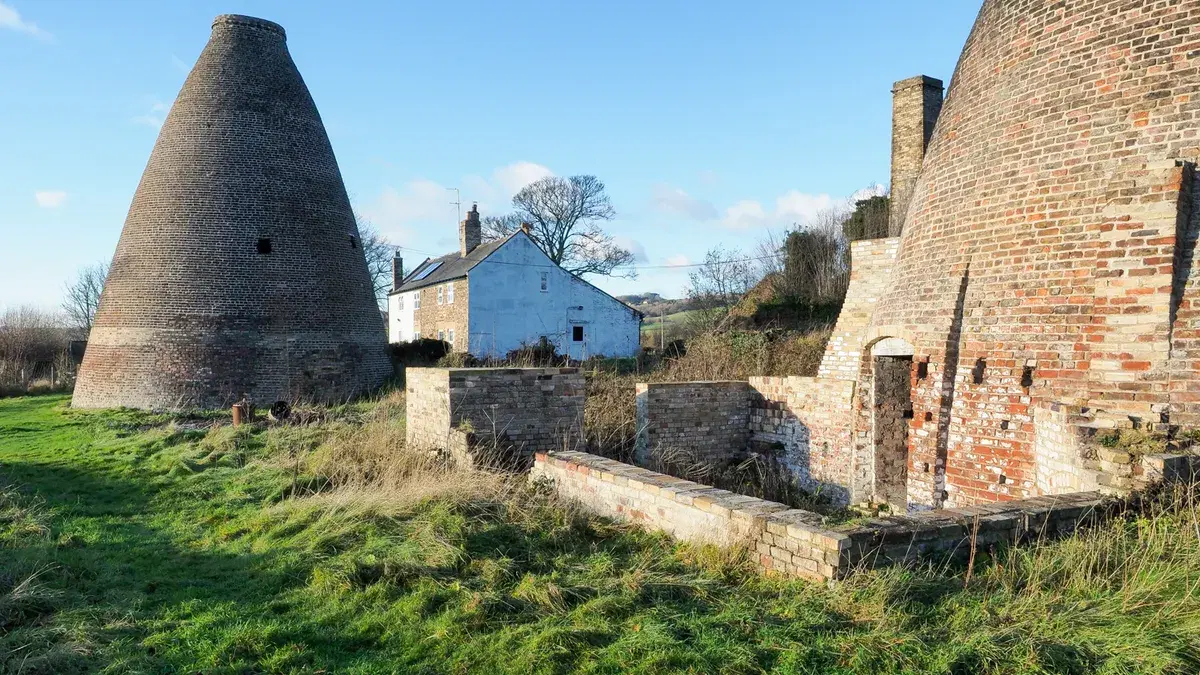
The most visible survivor of industrial Corbridge is the pottery on Milkwell Lane. A pottery was working here by 1855, and from the later 19th century it traded as the Corbridge Fire Brick and Sanitary Tube Works under Wylam Walker. Fireclay came by wagonway from a drift mine to the north-east, and the works made salt-glazed pipes, sanitary ware, firebricks, ridge tiles, chimney pots and agricultural pottery.
The works closed in the early 20th century, but two bottle kilns, Newcastle-type horizontal kilns and a down-draught kiln survive. The site is a scheduled monument, and the east bottle kiln, about 15 metres tall, is listed at Grade II*. It is a rare survivor of a rural Tyne Valley pottery.
Finding out more
The Corbridge Heritage Centre, run by volunteers in the former Methodist church on Princes Street, is a good place to explore the village's past further. Our guide to the history of Corbridge High Street looks at the shops and buildings along the main streets.
Local businesses mentioned
Corbridge Roman Town
Corchester Lane, Corbridge, Northumberland, NE45 5NT
The Angel of Corbridge
Main Street, Corbridge, Northumberland, NE45 5LA
JD Hall Family Butchers
2 Hill Street, Corbridge, Northumberland, NE45 5AA
Corbridge Community Partnership
Former Methodist Church, Princes Street, Corbridge, Northumberland, NE45 5DB
Never miss what’s on
Join the weekly CorbridgeVillage.live digest — the best events, news and local tips, straight to your inbox. One email a week.
What's On
Jim Ross Interviewed by LJ Ross
See organiser · Corbridge Community Hub, 19 Princes Street, Corbridge
Tynedale v Chester (National League 2 North)
2:00 PM · Tynedale Park, Station Road, Corbridge NE45 5AY
Remembrance Sunday Civic Service
10:40 AM · St Andrew's Church, Market Place, Corbridge NE45 5AA