The Oldest Pubs in Corbridge
The history behind Corbridge's pubs: a medieval tower turned micro bar, a 17th-century coaching inn, an inn dated 1765, a pub built from the stones of Dilston Hall, and what the listing records actually say.
Corbridge has a high share of old pubs for a village of its size. Five of its six pubs are in listed buildings, and one occupies a tower built around 1318. This guide is about the buildings and their history, in rough order of age. For beer, food, gardens and dogs, see our guide to the best pubs in Corbridge.
Dates here come from the Historic England list entries unless we say otherwise. Where a pub makes its own claim about its age, we say so, because the two do not always agree.
The Pele: a medieval tower
The oldest building in which you can buy a drink in Corbridge is the Vicar's Pele, the small fortified tower in the south-east corner of St Andrew's churchyard. It is listed at Grade I with a date of about 1318, and it is also a scheduled monument. Its walls are around 1.3 metres thick, and it was built partly with stone taken from the Roman town to the west of the village.
The tower was built to protect the vicar during the Border wars, when Scottish raids reached this far into the Tyne Valley. It was never an inn. Today it houses The Pele, a micro bar with a couple of handpumps, so the drinking history is recent even though the walls are not.
The Angel of Corbridge
The Angel of Corbridge on Main Street describes itself as dating back to at least 1569 and as the oldest inn in Northumberland. Historic England lists it at Grade II as a 17th-century inn, extended in the 18th century, so the listing does not confirm the 1569 date but does confirm that this is one of the oldest inn buildings in the village.
Look up as you go in. Above the main door is a sundial carrying the initials of Edward and Anne Winship, and beside the door is a four-light mullioned and transomed window, an older style than the sash windows on the rest of the front. The Angel stands where the road from the bridge meets Main Street, a natural place for an inn serving travellers crossing the Tyne.
The Black Bull
The Black Bull on Middle Street is listed at Grade II, and its list entry records the inn as dated 1765. The western part of the building is older still: it has a door surround dated 1755 but incorporates earlier fabric from what was once a separate house.
Inside, the low ceilings, snugs and open fires suit the age of the building, although like most old pubs it has been much altered over the centuries. It is now part of the Chef & Brewer group.
The Golden Lion
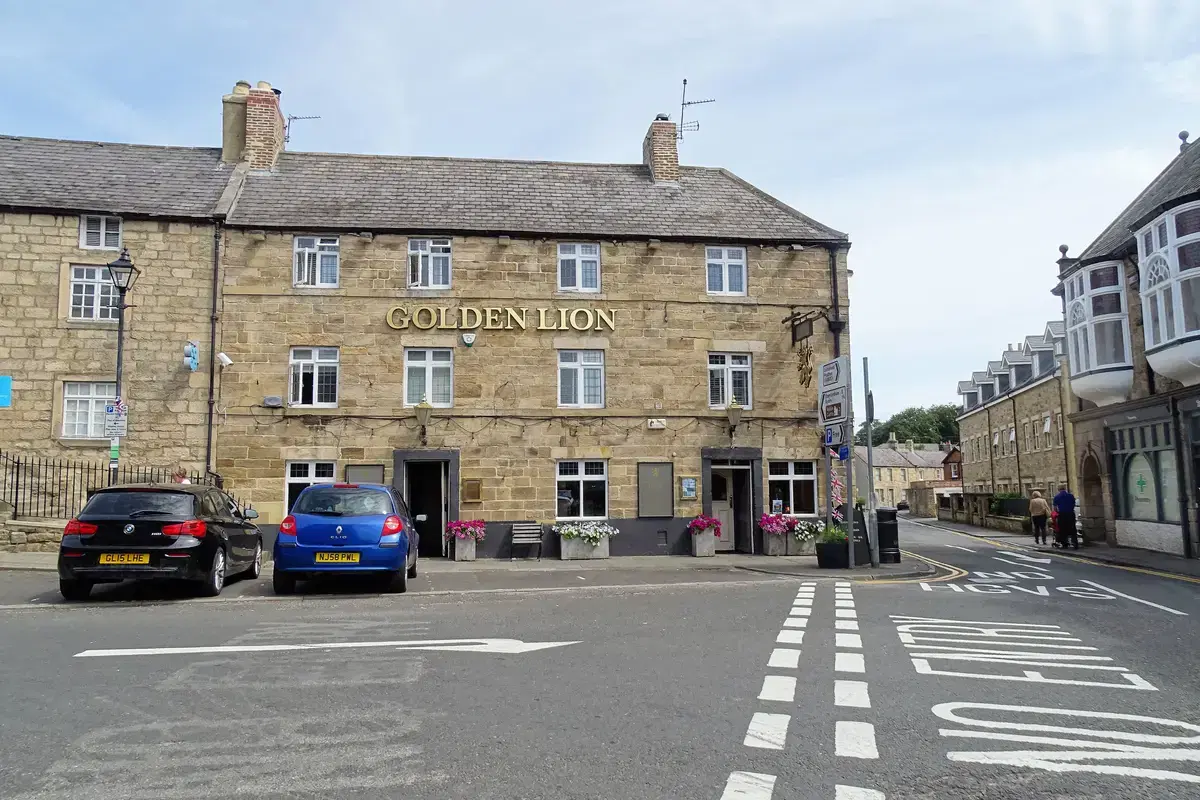
The Golden Lion is the large stone corner pub on Hill Street, facing the Town Hall. Historic England lists it at Grade II as a mid-18th-century inn, and the listing notes that it was built with materials from Dilston Hall.
Dilston, just south of the river, was the seat of the Radcliffe family, the Earls of Derwentwater. After the third Earl was executed for his part in the 1715 Jacobite rising, the estate was eventually taken over by the Greenwich Hospital trustees, who pulled down most of the hall in the 1760s. Some of that stone ended up here. Sources differ on the exact year of the demolition and of the pub's construction, so treat any single date you see quoted with care. The remaining tower of Dilston Castle still stands in the grounds of the Dilston estate.
The Wheatsheaf
The Wheatsheaf on St Helen's Street is an 18th-century stone building, listed at Grade II, and is first recorded as an inn in 1827. It sits at the top of Watling Street, on the northern edge of the old village. Outside, a listed 19th-century hydrant and water trough stands about 15 metres to the west, a reminder of how Corbridge got its water before mains supplies.
The pub reopened in May 2026 under new owners after a short closure.
The Dyvels
The Dyvels on Station Road, south of the river near Corbridge station, is the one pub in this list that is not a listed building, and we have not found a reliable date for it. It grew up in the railway age: the Newcastle and Carlisle Railway reached Corbridge in the 1830s, and the station building on the opposite side of the road is itself listed.
Lost inns
Corbridge once had more inns than it does now, as you would expect on a main road and river crossing. Monksholme on Main Street, almost opposite Low Hall, was once the New Inn. It is now a private house and listed at Grade II, so look from the street only.
Visiting
All of these pubs are within about a kilometre of each other, so you can see the lot on foot in an hour or so. Our Corbridge heritage walking trail links them up with the bridge, the church and the medieval towers. Opening hours change, and the Pele in particular opens on fewer days than the others, so check with each pub before you set out.
Local businesses mentioned
The Pele
Market Place, Corbridge, Northumberland, NE45 5AW
The Angel of Corbridge
Main Street, Corbridge, Northumberland, NE45 5LA
Black Bull
Middle Street, Corbridge, Northumberland, NE45 5AT
The Golden Lion
Hill Street, Corbridge, Northumberland, NE45 5AA
The Wheatsheaf
St Helens Street, Corbridge, Northumberland, NE45 5HE
The Dyvels Inn
Station Road, Corbridge, Northumberland, NE45 5AY
Never miss what’s on
Join the weekly CorbridgeVillage.live digest — the best events, news and local tips, straight to your inbox. One email a week.
What's On
Jim Ross Interviewed by LJ Ross
See organiser · Corbridge Community Hub, 19 Princes Street, Corbridge
Tynedale v Chester (National League 2 North)
2:00 PM · Tynedale Park, Station Road, Corbridge NE45 5AY
Remembrance Sunday Civic Service
10:40 AM · St Andrew's Church, Market Place, Corbridge NE45 5AA