Interesting Facts About Corbridge
Fourteen facts about Corbridge, from the Roman town of Coria and the Corbridge Hoard to a silver tray found by a nine-year-old girl, a king's treasure hunt, a murdered Northumbrian king and the only Tyne bridge to survive the 1771 flood.
Corbridge looks like a quiet Tyne Valley village, but it has been lived in for nearly two thousand years and has a habit of turning up surprises. Some of these facts are well known locally, and some are tucked away in museum captions and old chronicles. Where a story is uncertain, we say so.
1. It was a Roman town called Coria
The Roman settlement half a mile west of the village is usually called Corstopitum or Coriosopitum, but writing tablets found at Vindolanda suggest the Romans themselves called it Coria. English Heritage describes it as one of only two substantial towns in the Hadrian's Wall zone, about two and a half miles south of the Wall itself.
It began as a fort in around AD 86, and after a fire in about AD 105 a second fort was built on the same spot. From around AD 160 a town grew up there, with a walled military compound in the middle, and it was lived in until the early 5th century. You can walk its main street today at Corbridge Roman Town.
2. It sat on the main Roman road into Scotland
Corbridge grew where Dere Street, the Roman road running north into Scotland, met the Stanegate, the east-west road that pre-dated Hadrian's Wall. Dere Street crossed the Tyne here on a Roman bridge, and the remains of its abutment survive on the south bank west of the village. Being at a crossroads made Corbridge a natural supply base for the army on the frontier.
3. The Corbridge Hoard holds some of the best Roman armour ever found
In 1964 archaeologists found a wooden chest buried in the Roman town. Inside were weapons, tools, writing tablets and, most remarkably, parts of several suits of Roman segmented plate armour. English Heritage describes the armour as the best preserved ever found, and it changed how historians understand the way this kind of armour was put together. The hoard is on display in the site museum. See our guide to visiting Corbridge Roman Town for opening times.
4. The Corbridge Lion was once a fountain
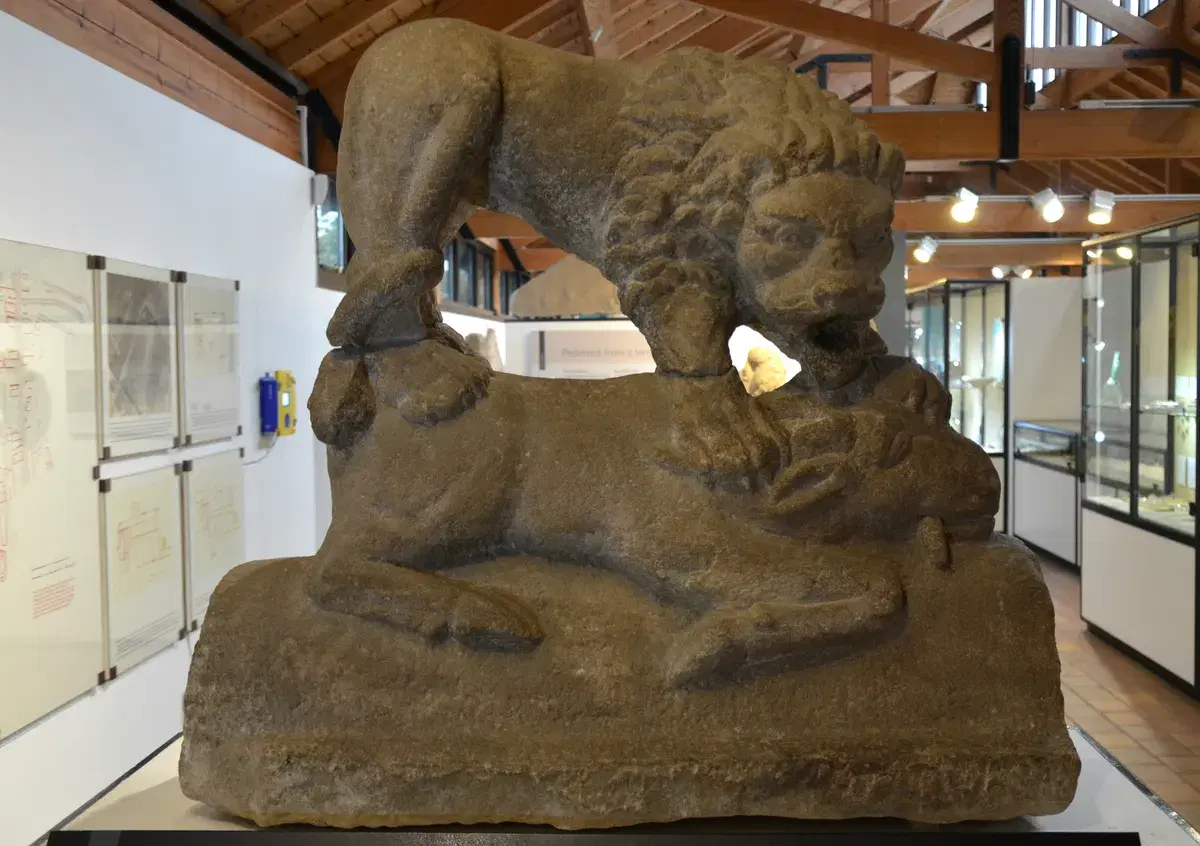
The site museum's most photographed piece is the Corbridge Lion, a stone sculpture of a lion standing over a stag. It probably started life on a Roman tomb, but it was later reused as a fountain, with water running out of its mouth. It is shown at the top of this page.
5. A nine-year-old girl found a Roman silver treasure
In February 1735, Isabel Cutter, the nine-year-old daughter of a local cobbler, found a large silver tray on the bank of the Tyne near Corbridge. Now known as the Corbridge Lanx, it is a 4th-century Roman dish about 50 cm wide and weighing over 4 kg, decorated with the gods Apollo, Artemis and Athena. It was kept by the Dukes of Northumberland for more than 250 years before the British Museum bought it in 1993.
6. King John came looking for treasure in 1201
Corbridge's Roman ruins had a reputation for hidden riches long before modern archaeology. In 1201 King John had men dig in the ruins in search of treasure. According to the chronicler Roger of Hoveden, all they found were stones marked with bronze, iron and lead.
7. A king of Northumbria was killed here
Corbridge was an important place in the Anglo-Saxon kingdom of Northumbria. In April 796 King Æthelred I of Northumbria was killed at Corbridge by a group of his own nobles. The village was also near the site of a battle in 918 between the Viking leader Ragnall and an alliance of the Scots under King Constantine II and the English of Bamburgh. Accounts of the outcome differ, and most historians call it indecisive.
8. St Andrew's Church is built partly from Roman stone
St Andrew's Church dates back to the 7th century, and tradition links its founding to St Wilfrid of Hexham. Much of its stone was taken from the Roman town, and the arch between the tower and the nave is a complete Roman arch, thought to have been taken down and rebuilt here. It is one of the stops on our Corbridge heritage walking trail.
9. The vicar lived in a fortified tower
Standing in the churchyard of St Andrew's is the Vicar's Pele, a stone tower house built in the 14th century to protect the vicar during the centuries of Border raiding. It is one of only three fortified vicarages known in Northumberland. The danger was real: Scottish forces under William Wallace burned Corbridge in 1297, and the village was attacked again in the following decades.
10. Its bridge survived the great flood of 1771
Corbridge Bridge, the seven-arched stone bridge over the Tyne, was built in 1674. In November 1771 a huge flood swept down the Tyne and destroyed or badly damaged every other bridge on the river, including the medieval bridge at Newcastle. Historic England records Corbridge's as the only bridge in Tynedale to survive. It still carries traffic today.
11. A pub was built from a beheaded earl's house
The Radclyffe family, Earls of Derwentwater, lived at Dilston Hall, just south-west of the village. After James Radclyffe, the 3rd Earl, was executed for his part in the Jacobite rising of 1715, the estate was taken by the Crown and passed to Greenwich Hospital, and the hall was later pulled down. Stone from Dilston Hall was used to build the Golden Lion on Hill Street. Read more about him in our guide to famous people from Corbridge.
12. The railway turned it into a commuter village
The Newcastle and Carlisle Railway, one of the earliest main lines in the country, opened through Corbridge in 1838. It made the village an easy trip from Newcastle, and in the Victorian period merchants and businessmen built large houses on the slopes above the village, including along Prospect Hill. The station is still in use on the Tyne Valley line. The Town Hall in the Market Place, designed by Frank Emley, followed in 1887.
13. It was home to a huge horse and cattle fair
For centuries one of the biggest fairs in the North was held at Stagshaw Bank, on the high ground just north of Corbridge, every July. Drovers brought cattle, sheep and horses from across the Borders to be sold. In more recent times the Northumberland County Show was held near Corbridge for many years before moving to Bywell in 2013.
14. It may have inspired Rudyard Kipling
In Puck of Pook's Hill (1906), Rudyard Kipling wrote about Roman soldiers on Hadrian's Wall, and the frontier town he calls Hunno is generally thought to be based on Roman Corbridge.
A few numbers
- Population: 3,672 at the 2011 census.
- Distance to Hexham: about 4 miles west.
- Distance to Newcastle: about 17 miles east.
- Age of the bridge: more than 350 years.
Best for:
Many of these places can be seen in a single morning. Start at the Roman Town, then walk into the village for St Andrew's Church, the Vicar's Pele, the Market Place and the bridge. Our heritage walking trail puts them in order, and the guide to Corbridge's oldest pubs covers the history of the Angel, the Golden Lion and others.
Spotted something we've missed, or know a Corbridge fact we should add? Get in touch and let us know.
Local businesses mentioned
Corbridge Roman Town
Corchester Lane, Corbridge, Northumberland, NE45 5NT
St Andrew's Church, Corbridge
St Andrew's Church, Market Place, Corbridge, Northumberland, NE45 5AA
The Golden Lion
Hill Street, Corbridge, Northumberland, NE45 5AA
The Angel of Corbridge
Main Street, Corbridge, Northumberland, NE45 5LA
Never miss what’s on
Join the weekly CorbridgeVillage.live digest — the best events, news and local tips, straight to your inbox. One email a week.
What's On
Jim Ross Interviewed by LJ Ross
See organiser · Corbridge Community Hub, 19 Princes Street, Corbridge
Tynedale v Chester (National League 2 North)
2:00 PM · Tynedale Park, Station Road, Corbridge NE45 5AY
Remembrance Sunday Civic Service
10:40 AM · St Andrew's Church, Market Place, Corbridge NE45 5AA