Famous People From Corbridge
The notable people born in or connected to Corbridge, from the Jacobite Earl of Derwentwater at nearby Dilston to footballers Steve Bruce and Alan Brown, scout Graham Carr, horror novelist John Blackburn and folk singer Rachel Unthank.
For a village of under 4,000 people, Corbridge has produced or been home to a surprising number of well-known names. This guide covers people with a clear, documented link to the village, and says what that link is: whether they were born here, lived here, or are tied to Corbridge by a particular event.
We have left out people where the only source is hearsay. If you know of someone we have missed, and can point to where the connection is recorded, please let us know.
Born in Corbridge
Steve Bruce, footballer and manager
Steve Bruce was born in Corbridge on 31 December 1960. He grew up on Tyneside and became one of the most successful centre-backs of his generation, captaining Manchester United through the early years of their Premier League dominance in the 1990s and winning the league, the FA Cup and the European Cup Winners' Cup. As a manager he has taken charge of more than a dozen clubs, including Sunderland, Hull City, Aston Villa and, from 2019 to 2021, Newcastle United, the club he supported as a boy. His most recent job was at Blackpool, which ended in October 2025.
Alan Brown, footballer and manager
Alan Brown (1914 to 1996) was born in Corbridge. A centre-half, he played for Huddersfield Town, Burnley and Notts County, and played for Burnley in the 1947 FA Cup final, which they lost to Charlton Athletic. He went on to manage Burnley, Sunderland (twice) and Sheffield Wednesday, whom he led to the 1966 FA Cup final, where they lost 3-2 to Everton after being 2-0 up. He had a reputation as a strict disciplinarian.
Graham Carr, football manager and scout
Graham Carr was born in Corbridge on 25 October 1944. After a playing career mostly in the lower leagues, he managed Northampton Town to the Fourth Division title in 1986-87, a season in which they scored over 100 league goals. He later became one of the best-known scouts in English football, working as Newcastle United's chief scout from 2010 to 2017, a period in which the club signed players such as Yohan Cabaye and Cheick Tioté. He is the father of the comedian and broadcaster Alan Carr.
John Blackburn, novelist
John Blackburn (1923 to 1993) was born in Corbridge, the son of a clergyman. He wrote more than 25 thrillers and horror novels, starting with A Scent of New-Mown Hay (1958), a bestseller about a mutated fungus. His novel Nothing But the Night (1968) was made into a film released in 1973, starring Christopher Lee and Peter Cushing. The Times Literary Supplement once called him "today's Master of Horror".
Lived in Corbridge
Dame Catherine Cookson, novelist
Catherine Cookson, the South Shields-born author who became one of the most-borrowed writers in British libraries, lived in Corbridge for a time after she and her husband Tom came back to the North East from Hastings. They later moved to Langley, near Haydon Bridge, and then to Jesmond in Newcastle, where she died in 1998.
Ruth Ainsworth, children's author
Ruth Ainsworth (1908 to 1984) wrote dozens of children's books, including the Rufty Tufty series about a rag doll, and many of the stories read on the BBC radio programme Listen with Mother. Her last home was in Corbridge, where she spent her later years.
Rachel Unthank, folk singer
Rachel Unthank, one half of the sister duo at the heart of the Mercury-nominated folk group The Unthanks, lives in Corbridge. The band's 2015 album Mount the Air was recorded in a studio in a converted granary in Corbridge, near the home she shares with Adrian McNally, the group's pianist, producer and composer.
Connected by history
James Radclyffe, 3rd Earl of Derwentwater
The most famous name in Corbridge history belongs to Dilston, just over a mile south-west of the village across the Tyne. James Radclyffe was born there in 1689, a grandson of King Charles II through his mother. A Catholic, he joined the Jacobite rising of 1715, was captured at the Battle of Preston and was beheaded on Tower Hill in London on 24 February 1716, aged 26.
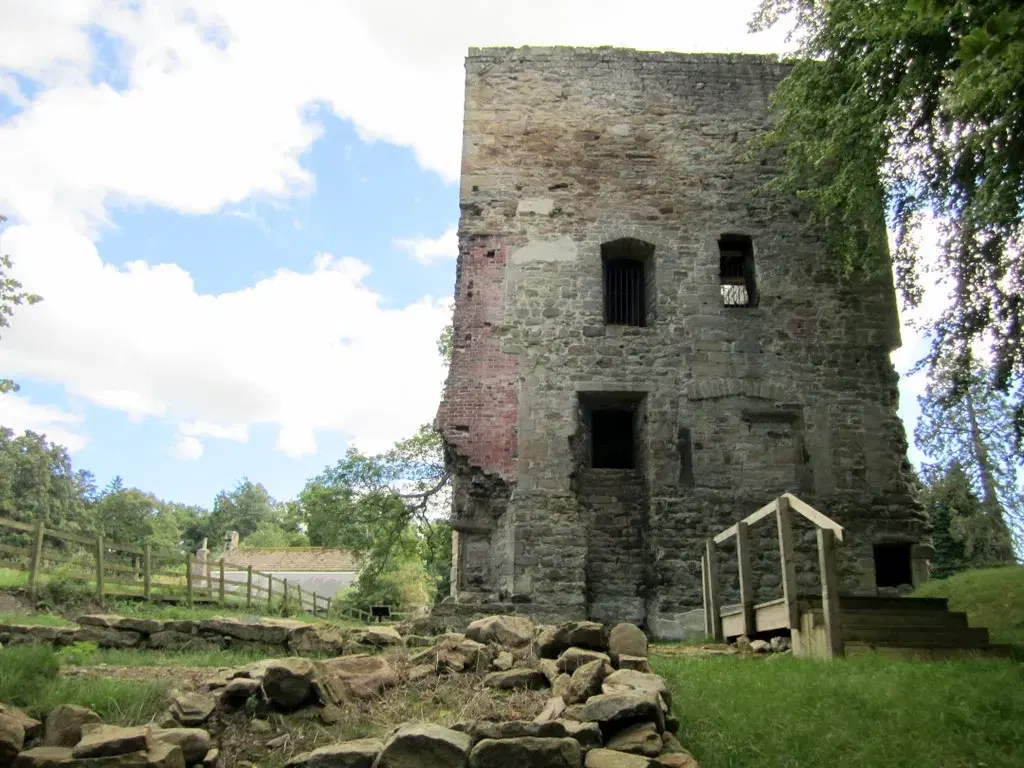
The aurora borealis was unusually bright on the night of his execution, and in Northumberland the northern lights became known as "Lord Derwentwater's Lights". His estates were confiscated and later given to Greenwich Hospital, and Dilston Hall was demolished. Stone from the hall was used to build the Golden Lion on Hill Street in Corbridge. The ruined 15th-century tower of Dilston Castle, shown at the top of this page, and the family chapel still stand in the grounds.
Isabel Cutter, finder of the Corbridge Lanx
Very little is known about Isabel Cutter, but she is responsible for one of the most important Roman finds ever made in Britain. In February 1735, aged nine, she found a large silver tray on the bank of the Tyne near Corbridge. The Corbridge Lanx, a 4th-century dish decorated with Apollo, Artemis and Athena, is now in the British Museum. See our interesting facts about Corbridge for more.
Rowan Atkinson and the church doors
Several travel guides record that the glass inner doors at St Andrew's Church were given by the actor Rowan Atkinson and his family in memory of his mother, who lived in the village and worshipped at the church. Atkinson grew up in County Durham, and his family's connection to Corbridge is through her. We have not found the gift recorded in the church's own material, so if you can confirm the detail, please get in touch.
Best for:
To see the places linked to these people, start at Corbridge Roman Town, where the Corbridge Hoard and other finds are displayed, then follow our heritage walking trail through the village. Dilston is a short walk south-west of the village across the bridge; see our guide to walks around Corbridge.
Spotted something we've missed, or know a famous name with a Corbridge connection? Get in touch and let us know.
Never miss what’s on
Join the weekly CorbridgeVillage.live digest — the best events, news and local tips, straight to your inbox. One email a week.
What's On
Jim Ross Interviewed by LJ Ross
See organiser · Corbridge Community Hub, 19 Princes Street, Corbridge
Tynedale v Chester (National League 2 North)
2:00 PM · Tynedale Park, Station Road, Corbridge NE45 5AY
Remembrance Sunday Civic Service
10:40 AM · St Andrew's Church, Market Place, Corbridge NE45 5AA