Corbridge in World War Two: Memorials, a Wartime Maternity Home and the Airfield Up the Road
How the Second World War left its mark on Corbridge, from the 25 names on the village war memorial and the plaque in St Andrew's to Dilston Hall's wartime maternity home and the fighter station at RAF Ouston.
Corbridge saw no great battle in the Second World War, and its wartime story is a quiet one. It is told mostly through names: the 25 men from the parish who did not come home, a schoolboys' memorial in a block of flats, and a country house just across the Tyne where hundreds of Newcastle babies were born while the city was under threat of bombing. This guide brings those traces together, with directions to where you can still see them.
The village war memorial
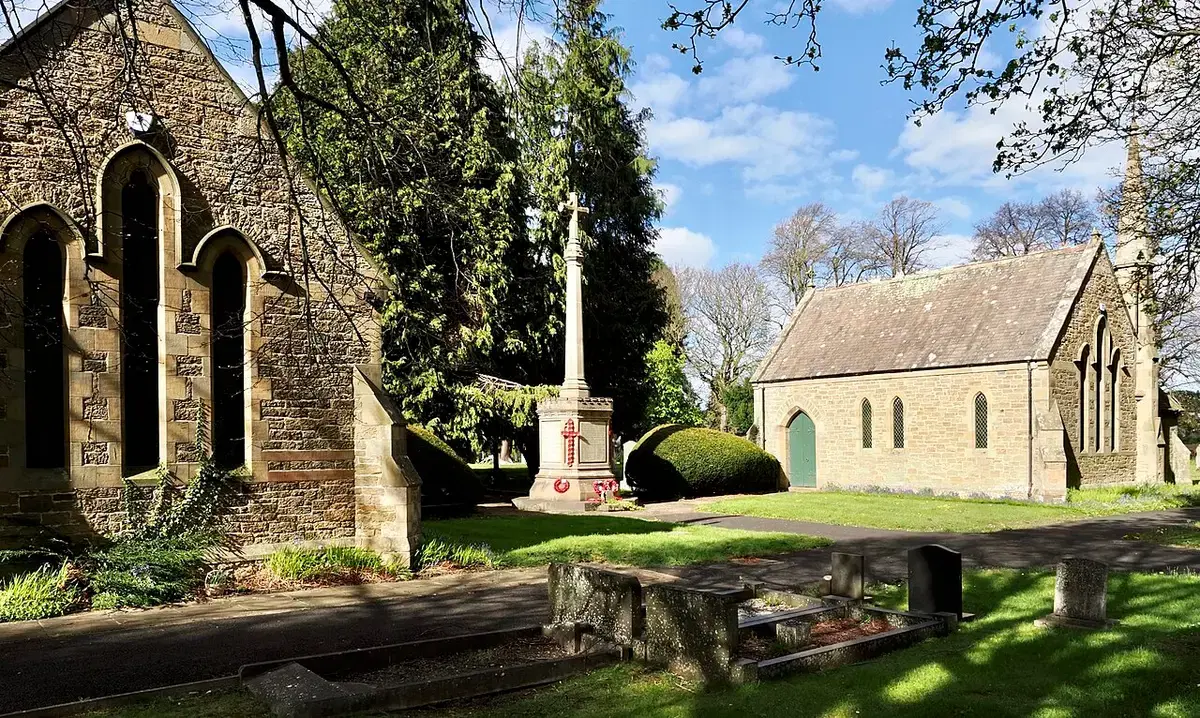
The main memorial stands in Corbridge Cemetery on Dilston Road, just inside the gates and between the two stone mortuary chapels. It is a tall Latin cross, about nine metres high, on a square plinth with a crenellated top, and it is easy to see from the road.
The cross was unveiled in October 1921 to remember the First World War. It was designed by W W Woods of Newcastle, carved by the sculptor Robert Beall, and paid for, at a cost of about £800, by the families of the men it names. The inscription says it was "erected by the parents and friends of the men from the parishes" of Corbridge, Dilston, Halton and Whittington, which is why you will sometimes see it called the Corbridge, Dilston, Halton and Whittington War Memorial.
It carries 111 names from 1914 to 1918. After the Second World War, 25 further names were added in 1948. The memorial was restored in the 1990s, and in July 2016 it was listed at Grade II by Historic England, and it is open to visit whenever the cemetery is.
Inside St Andrew's Church
St Andrew's Church, the Saxon parish church beside the Market Place, holds the village's own Second World War tablet. It is on the west wall of the south aisle and reads simply: "In memory of those from this parish who died in the World War 1939 to 1945", followed by 25 names. An aumbry lamp on the north wall of the Lady Chapel is also part of the parish's remembrance.
Look too for a small but moving personal memorial in the sanctuary, to the south of the altar. It is an oak and stainless steel candlestick inscribed to Michael Graham Angus, born on 30 July 1923 and missing at Anzio on 9 February 1944. Anzio was the hard-fought Allied landing south of Rome, and Michael was 20 years old.
The church is open daily for private prayer from 9.30am to 4pm, and our guide to Corbridge's churches covers its longer history.
The Corchester School memorial
Corbridge once had a boys' school, Corchester School, on Corchester Lane. The school has long gone and its building is now Corchester Towers, a block of flats, but its war memorial survives in the entrance hall. It is a set of bronze plaques in a wooden frame, dedicated with the words "These Old Corchester Boys fought and died for their country".
The plaques list 11 former pupils who died in the First World War and 22 who died in the Second. That is a striking number for one small school, and a reminder of how heavily the officer class of both wars was drawn from schools like it. As the memorial is inside a private residential building, it is not open to visitors, but it is recorded by the Imperial War Museum's War Memorials Register.
Dilston Hall: a wartime maternity home
The most unusual part of Corbridge's war happened just south of the river at Dilston Hall, the house beside the ruins of Dilston Castle. In 1942, after Lord Allendale moved his household to Bywell, he made the Hall available as a maternity refuge for the Newcastle hospitals. The idea was to give expectant mothers from Tyneside a safer place to give birth, away from the city and the risk of air raids.
Mothers were booked in through antenatal clinics at Hexham General, Throckley and Forest Hall. By July 1948, when the Regional Hospital Board took over the home under the new National Health Service, a letter recorded 600 admissions and 563 deliveries. Pressure on Newcastle's maternity beds was serious enough to be raised in Parliament in March 1944.
Dilston Hall stayed a maternity home until 1965, when births moved to a new unit at Hexham General Hospital. It later passed to the charity Mencap and is now part of Dilston College. Northumberland Archives has written about the maternity home, and its collections at Woodhorn are the place to look if you think a relative was born there.
RAF Ouston, the fighter station up the road
The nearest wartime airfield to Corbridge was RAF Ouston, about eight miles north-east near Stamfordham. It opened on 10 March 1941 as a fighter sector headquarters under No. 13 Group, taking over from RAF Usworth as the sector station for the area. Over the following years it was home to squadrons flying Hurricanes, Spitfires, Typhoons and Beaufighters, and from June 1943 to a training unit that taught radar operators for night fighters.
After the war, No. 607 (County of Durham) Squadron re-formed at Ouston in 1946. The station passed to the Army in 1974 and is now Albemarle Barracks, so it is not open to the public.
Researching your own family
If you are tracing someone named on the memorials, the Imperial War Museum's War Memorials Register and the Commonwealth War Graves Commission website are good places to start. Corbridge Library on Hill Street is a handy place to use the internet and ask about local history resources, and Northumberland Archives at Woodhorn holds parish, school and hospital records for the area.
For more on the village's past, see our guides to the lost buildings of Corbridge and the Corbridge heritage walking trail.
Never miss what’s on
Join the weekly CorbridgeVillage.live digest — the best events, news and local tips, straight to your inbox. One email a week.
What's On
Jim Ross Interviewed by LJ Ross
See organiser · Corbridge Community Hub, 19 Princes Street, Corbridge
Tynedale v Chester (National League 2 North)
2:00 PM · Tynedale Park, Station Road, Corbridge NE45 5AY
Remembrance Sunday Civic Service
10:40 AM · St Andrew's Church, Market Place, Corbridge NE45 5AA