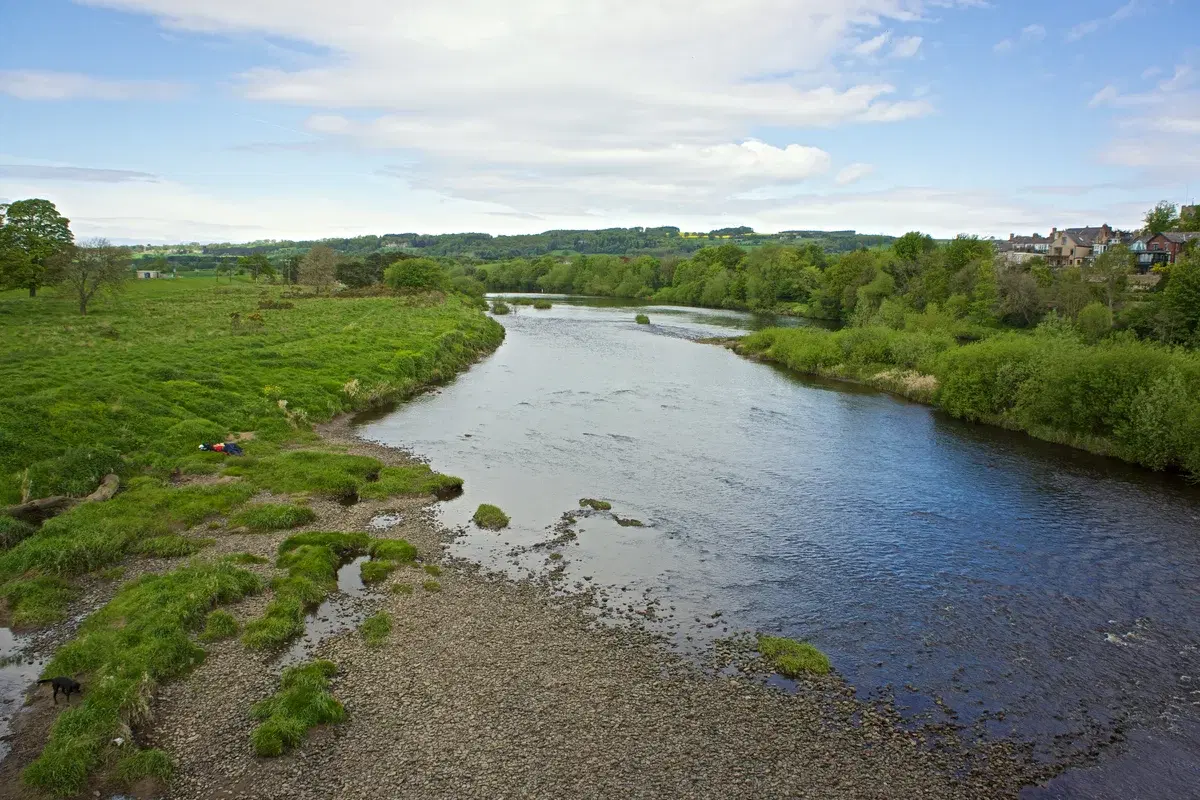
The River Tyne runs right past Corbridge, under the 1674 bridge and along The Stanners, and for game anglers it is one of the most important rivers in the country. This guide explains why, where you can fish around the village, and the rules you need to know before you cast a line.
One thing to be clear about first: almost all fishing on the Tyne is privately owned. You cannot simply turn up on the bank at Corbridge and fish. You need both a rod licence from the Environment Agency and permission from whoever owns or manages the fishing rights, usually by buying a day permit or booking a beat.
England's leading salmon river
The Tyne's recovery is one of the great river stories of the North East. Its salmon stocks began to recover from the late 1960s as water quality in the estuary improved. When Kielder Reservoir was built and cut off around 7% of the catchment, the Kielder Salmon Centre was set up in 1978 to compensate. In 2018 it released around 360,000 young salmon and 20,000 sea trout into the river system.
The figures now speak for themselves. In the Environment Agency's salmonid statistics for 2025, published in September 2026, the Tyne had the highest declared rod catch in England and Wales of both salmon (1,154) and sea trout (933). That was in a difficult year nationally: the total declared salmon catch across England and Wales was 4,053, down by about a third, and 98.1% of salmon caught on rods were released. In October 2024, the Environment Agency said the Tyne was the only river in England whose salmon stocks were still classed as "not at risk".
Much of that run passes Corbridge. The Environment Agency's fish counter at Riding Mill, a few miles downstream, was installed in 1996, and in July 2015 it recorded more than 10,000 fish moving upstream in a single month, almost all of them sea trout and salmon.
For the story of the river itself, its floods and the bridge that survived them, see our guide to the Tyne at Corbridge.
Where to fish near Corbridge
We have not been able to confirm any public or village stretch of the Tyne at Corbridge itself that is open to visiting anglers, so we have not listed one. These are the options we could verify nearby.
Bywell, on the Allendale Estates
The Bywell fishing on the Allendale Estates covers around two and a half miles of the Tyne through the estate at Bywell, downstream of Corbridge. It has 12 main pools fished by five rods, from the bank, by boat and by wading, with two fishing huts and a full-time ghillie. The estate quotes a five-year average of 256 salmon. Availability and prices are by enquiry through the Allendale Estates website, by email to info@allendale-estates.co.uk or on 01661 843296.
Tyne Green Country Park Fishery, Hexham
Northumberland County Council manages a fishery at Tyne Green in Hexham, about three miles upstream. It covers the south bank from the old Border Counties Railway bridge to the Hexham road bridge. You need a council permit as well as a rod licence, and only one rod is allowed. The council's rules include a daily bag limit of four fish, a 25cm minimum size for brown trout, no fishing at night and no dogs. Check permit prices and where to buy them with the council before you go.
Tyne Angling Passport
The Tyne Rivers Trust, which is based at Stagshaw just outside Corbridge, runs the Tyne Angling Passport. It offers 20 wild trout beats on the Tyne, North Tyne, Derwent, Rede and South Tyne at £8 a day, mainly for wild brown trout. It is the most affordable way to try river fishing in the catchment.
Other commercial beats
The Trust says most of the commercial game fishing beats on the Tyne can be booked through FishTyne. If you want salmon or sea trout fishing close to Corbridge beyond Bywell, that is the place to look, and the Trust can point you in the right direction.
Best for: Good for: Bywell suits experienced salmon anglers who want a ghillie; the Angling Passport is the low-cost way into wild trout fishing.
Seasons
The Environment Agency's byelaws for the North East set these seasons on the Tyne:
| Species | Season open | Close season |
|---|---|---|
| Salmon | 1 February to 31 October | 1 November to 31 January |
| Sea trout | 3 April to 31 October | 1 November to 2 April |
| Brown trout | 22 March to 30 September | 1 October to 21 March |
That means the salmon and sea trout season has just closed for the year, and it reopens for salmon on 1 February 2027.
Rod licences
Anyone aged 13 or over needs an Environment Agency rod licence to fish for salmon, sea trout or trout. Children under 13 do not need one, and 13 to 16-year-olds need a junior licence, which costs nothing. For salmon and sea trout you need the salmon and sea trout licence, not the standard trout and coarse licence. Licences are bought on GOV.UK. Fishing without one can lead to a fine of up to £2,500.
Holders of a salmon and sea trout licence must also send in a catch return to the Environment Agency.
Catch-and-release and other rules
The byelaws include several rules that matter on the Tyne:
- Before 16 June, salmon can only be fished for with artificial fly or lure, and every salmon caught must be released straight away.
- Minimum sizes apply to fish that are kept: 25.4cm for sea trout, and 22.5cm for brown trout on the Tyne below Hexham Bridge.
- No fishing near weirs. There are no-fishing zones of 25 metres upstream and 95 metres downstream of several weirs, including Riding Mill Weir, Hexham Bridge Weir and Devil's Water Dam, at night and through the autumn.
- Night fishing for salmon and sea trout is restricted.
- Selling rod-caught salmon or sea trout is illegal.
Individual fisheries often add their own rules on top, such as stricter catch-and-release or bag limits, so read the permit conditions as well. Release is now the norm well beyond 16 June: across England and Wales, 98.1% of rod-caught salmon were returned in 2025.
Staying safe on the river
The Tyne at Corbridge is a big river that can rise quickly after heavy rain upstream, and it can flood dramatically, as our river guide describes. Check the river level before you go, wade with care on the shingle and stony bed, and wear a lifejacket if you are wading or fishing from a boat. Stick to recognised paths and access points, and always ask permission before crossing private land to reach the water.
If you want to explore the river without a rod, our guide to walks around Corbridge includes riverside routes along the Tyne.
Do you run a fishery or angling club near Corbridge? Get in touch and we will add it to the directory and this guide.